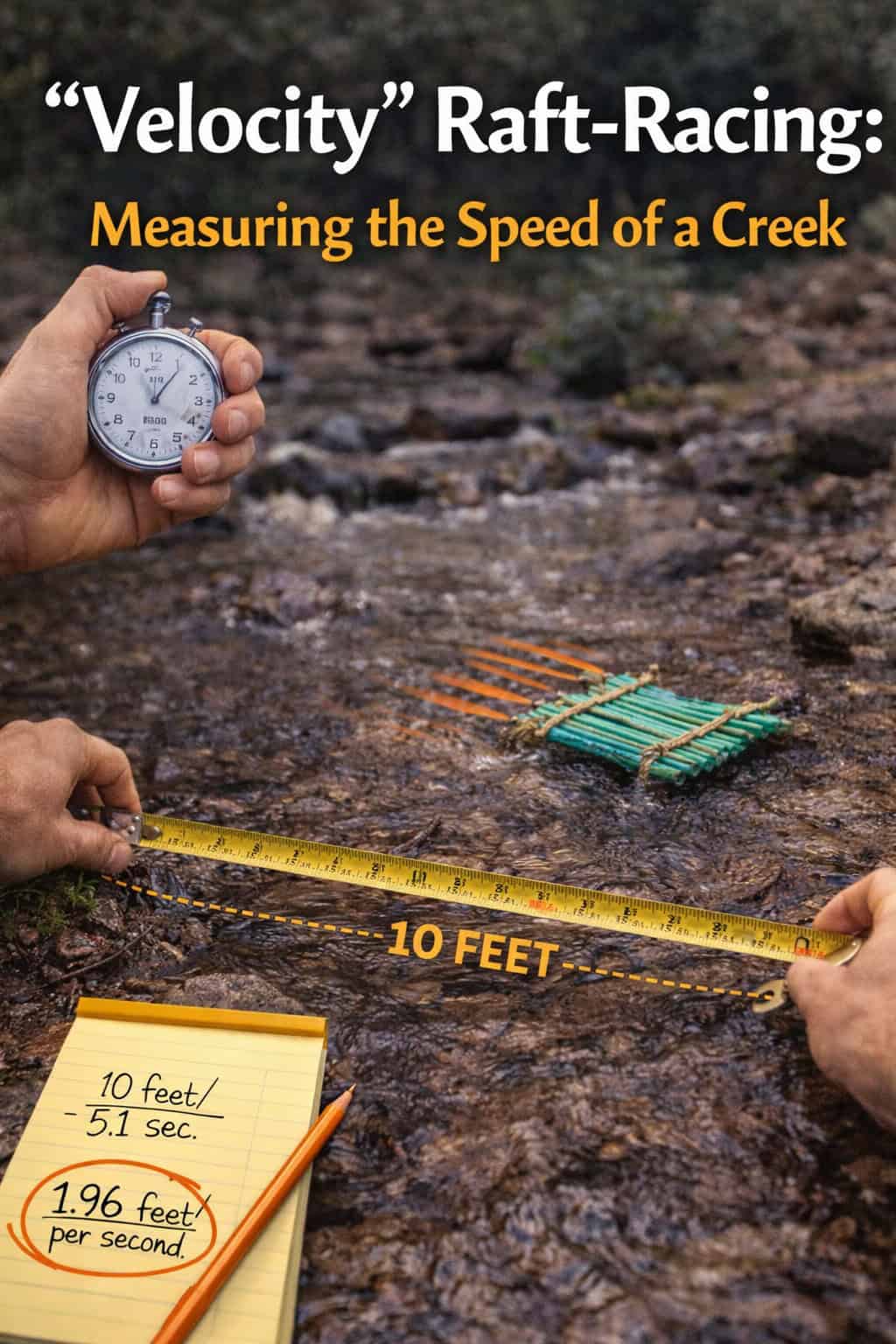
How to Turn a Stick and a Stopwatch into a High-Flow Science Lab
To most people, a creek is just a place to splash around. But to a Hydrologist, a creek is a "Conveyor Belt" of energy. The water is moving at a specific Velocity (speed in a certain direction), and that speed determines everything from which fish live there to how the riverbanks are shaped.
If you want to know how powerful your local creek is, you don't need a high-tech sensor. You just need a "Raft," a "Track," and a little bit of math. Welcome to the Creek Velocity Trials.
1. The Science of "Flow Velocity"
The Concept: Water in a creek doesn't all move at the same speed.
-
The Physics: Because of Friction, the water touching the bottom and the sides of the creek moves slower. The water in the middle, just below the surface, is usually the "Speed Champion."
-
The Math: To find the velocity, we use a simple formula:
$$Velocity = \frac{Distance}{Time}$$ -
The Goal: We want to see how many feet our "Raft" can travel in one second.
2. Building the "Science Raft"
The Problem: If you use a heavy rock, it will sink. If you use a leaf, the wind might blow it faster than the water is moving.
-
The Engineering: You need a "Neutral" raft. A small, dry stick about 4 inches long is perfect.
-
The Strategy: Pick a stick that is heavy enough to sit in the water, not just on it. This ensures you are measuring the speed of the current, not the speed of the breeze!
3. Setting Up the "Track"
To get an accurate reading, you need a controlled experiment zone.
-
The Action: Find a straight section of the creek (curves make the math messy!).
-
The Measurement: Use a tape measure (or your "Co-Captain" stride) to mark off exactly 10 feet along the bank.
-
The Markers: Place a "Start" rock and a "Finish" rock on the bank.
4. The "Velocity Trial" Experiment
-
The Launch: Go a few feet above your Start marker. Drop your stick into the middle of the current. (Dropping it early lets it get up to "Top Speed" before the timer starts).
-
The Timer: As soon as the stick passes the Start rock, hit the stopwatch on your phone.
-
The Finish: Stop the timer the moment the stick passes the Finish rock.
-
The Calculation: Let's say it took 5 seconds to go 10 feet.
-
$10\text{ feet} \div 5\text{ seconds} = 2\text{ feet per second!}$
-
5. The "Laminar" vs. "Turbulent" Factor
The Science: As you race your rafts, you'll notice the water looks different in different spots.
-
Laminar Flow: This is smooth, "glassy" water. The water molecules are all sliding past each other in straight lines. This is usually where your raft will be the fastest.
-
Turbulent Flow: This is "white water" or swirls (eddies). The water is tumbling over rocks, creating Kinetic Energy that moves in circles instead of straight ahead.
-
The Physics: Turbulent water is "wasting" speed to create foam and noise. If your raft gets caught in a "Whirlpool" (an eddy), its velocity might actually drop to zero!
Pro Tip: The "V-Shaped" Secret. Look at the surface of the creek. You’ll often see a "V" shape in the water pointing downstream. This is the Thalweg—the deepest and fastest part of the channel. If you want to win the "Raft Race," launch your stick right in the point of the V!
Final Thoughts
Measuring velocity tells you the "Pulse" of the forest. High velocity means the water is carving out the earth and moving big rocks. Low velocity means the water is "resting" and dropping sand to build new beaches. When you calculate the speed of the creek, you aren't just playing with sticks—you're analyzing the engine of the ecosystem.
Ready... Set... Launch!
🐟 Want to find a site with a "High-Velocity" racing lane? Look for sites near "Riffles" (shallow, rocky fast spots)! CampgroundViews.com lets you take a 360-degree tour of the park. You can zoom in on the creek next to each site to see where the water is moving fast and smooth for your next Raft-Racing Trial.
Find your "Race Track" at CampgroundViews.com!