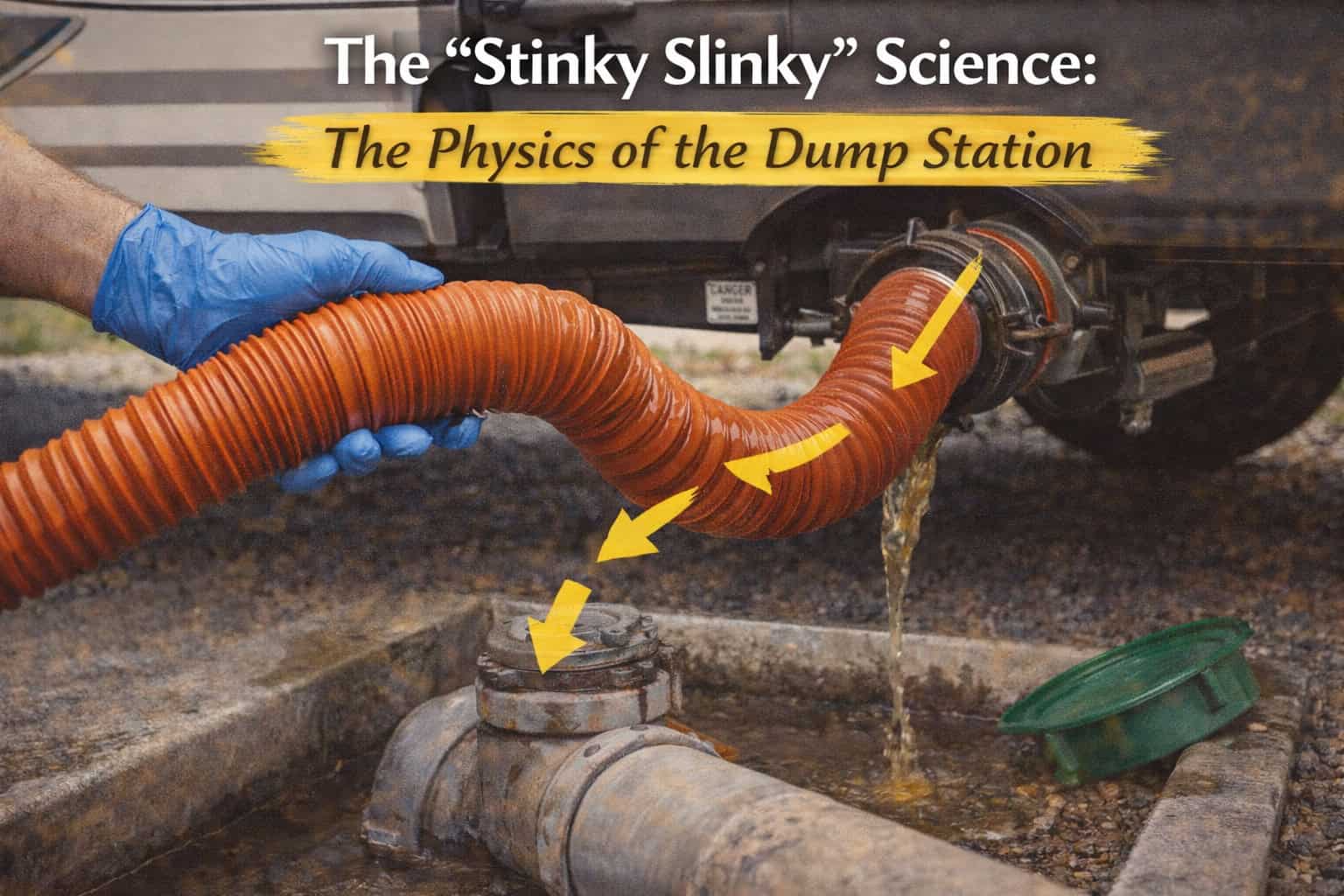
The "Stinky Slinky" Science: The Physics of the Dump Station
The Science Behind the Most "Important" RV Job
Let’s be honest: the sewer hose (affectionately known by RVers as the "Stinky Slinky") is the part of camping that everyone is a little bit grossed out by. But to a Co-Captain and a Science Scout, the dump station isn't just a chore—it’s a masterclass in Fluid Dynamics and Gravity.
When you understand the physics of how the tanks empty, the job becomes faster, cleaner, and way more interesting. Here is the "down and dirty" science of the dump station.
1. The "Power of Gravity" (Potential Energy)
The Science: RVs don't have electric pumps to empty their waste tanks. Instead, they rely on Potential Energy.
-
How it works: The waste tanks are mounted high up in the chassis of the RV, while the sewer inlet at the campground is in the ground.
-
The Physics: Gravity pulls the liquid downward. The higher the RV is compared to the hole in the ground, the more "head pressure" you have, which makes the waste move faster.
-
The Mission: Always make sure your hose has a "downhill" slope. if there is a "hump" in the middle of the hose, the liquid will get stuck!
2. The "Whoosh" Factor (The Bernoulli Principle)
The Science: When you pull the handle to open the tank, why does the water come out so fast at first and then slow down?
-
How it works: A full tank has a lot of weight pushing down on the exit pipe. As the tank empties, there is less weight (and less pressure).
-
The Physics: This is similar to the Bernoulli Principle. To get a "clean sweep" of the tank, you want a high-velocity flow.
-
Pro Tip: This is why we wait until the tank is at least 2/3 full before dumping. A full tank creates a powerful "Whoosh" that carries all the solids away. If the tank is nearly empty, it just "trickles" out and leaves a mess behind!
3. The "Black then Grey" Rule (The Cleaning Cycle)
The Science: In the world of RVing, we have two types of waste water: Black Water (from the toilet) and Grey Water (from the shower and sink).
-
The Logic: Black water is the "messy" stuff. Grey water is mostly just soapy water.
-
The Physics: You always dump the Black Tank first, then the Grey Tank second.
-
The Result: The soapy Grey water acts as a "Secondary Flush," rinsing out the inside of the Stinky Slinky so it’s much cleaner when you go to put it away. It’s a self-cleaning system designed by logic!
4. The "Clear Elbow" Observation Lab
The Science: How do you know when the tank is actually empty? You can't see through the black plastic hose!
-
The Gear: Pro RVers use a Clear Elbow Connector at the end of the hose.
-
The Observation: By watching the liquid through the clear plastic, you can see exactly when the "Whoosh" turns into a "Trickle."
-
The Result: When the water running through the clear elbow looks clean and clear, you know your tanks are successfully rinsed and ready for the next adventure.
5. The "Air Pressure" Secret (The Vent)
The Science: Have you ever noticed a small pipe sticking out of the roof of the RV? That’s the Tank Vent.
-
The Physics: For liquid to go out of the tank, air has to go in. If the vent was blocked, it would create a vacuum, and the tank wouldn't empty—it would just "glug" like a water bottle turned upside down.
-
The Mission: As a Co-Captain, make sure nobody is sitting on the roof near the vent when you’re dumping, and listen for that "glug-glug" sound!
Pro Tip: The "Sewer Support" Bridge. Use a plastic "hose support" (it looks like a long accordion bridge). It keeps the Stinky Slinky off the ground and ensures a perfect, straight-line "Slide" for the waste to travel down. Physics loves a straight line!
Final Thoughts
The dump station might be a little bit "stinky," but it’s a brilliant example of how we use the natural laws of the universe to keep our "Rolling Homes" clean. Once you master the "Whoosh" and the "Gravity Slope," you’ll be the most efficient Co-Captain in the park.
Science is everywhere—even in the sewer!
🐟 Want to make sure your site has a "downhill" slope for your hose? You can see the ground before you go! CampgroundViews.com lets you take a 360-degree tour of the park. You can look at exactly where the sewer drain is located in the site and see if the ground is flat or sloped.
Check your slope at CampgroundViews.com!