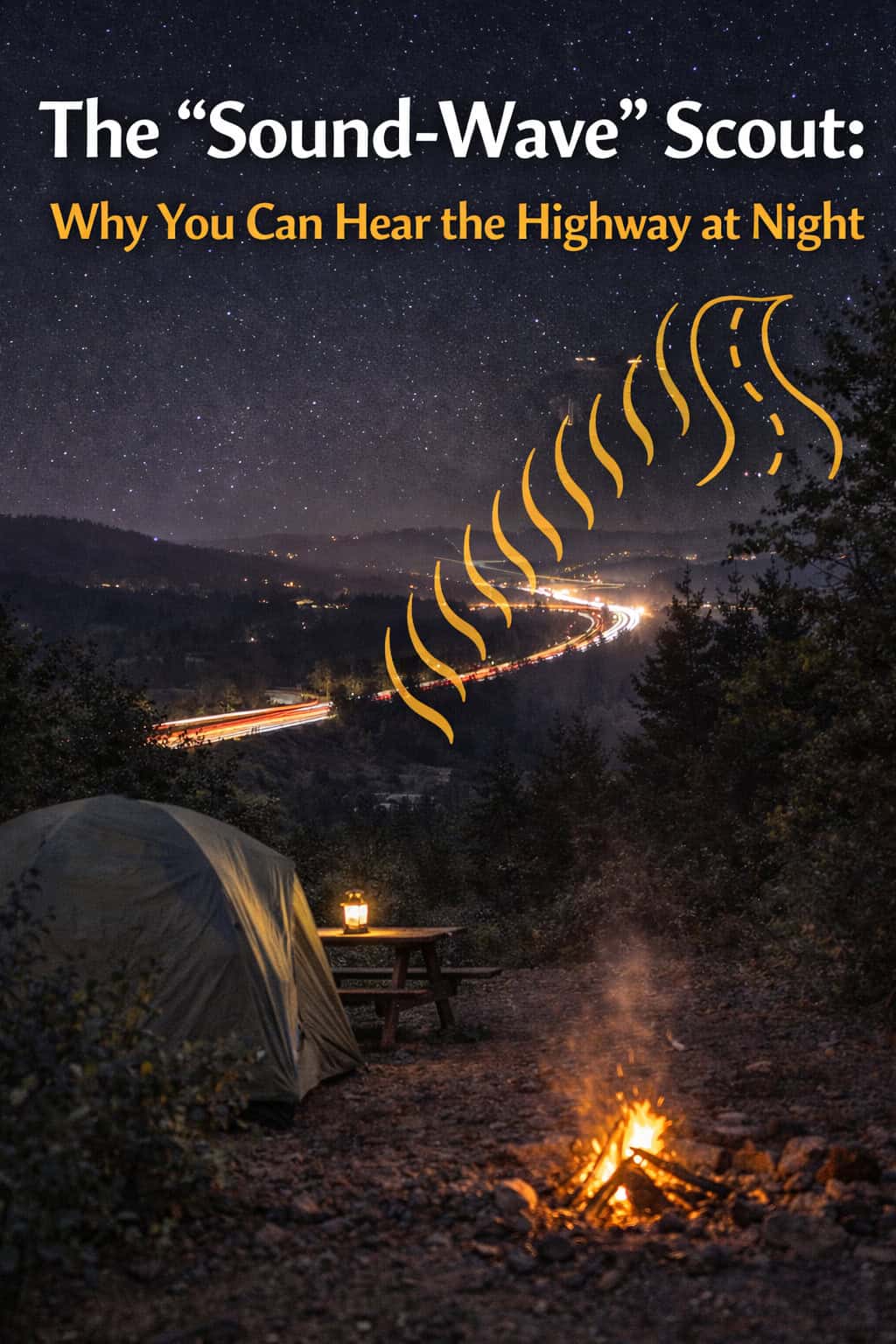
How the Atmosphere Turns into a Giant Acoustic Lens
You’re tucked into your bunk, the campground is silent, and suddenly you hear it: the low hum-hum-hum of tires on the highway or the distant whistle of a train. But wait—that highway is three miles away! During the day, you couldn't hear a thing. Did the cars get louder? Did your ears get "superpowers" in the dark?
No, the road didn't move. You are witnessing a phenomenon called Acoustic Refraction. At night, the atmosphere actually "bends" sound waves back down toward your ears. Here is the science of the Nighttime Megaphone.
1. The "Speed of Sound" Variable
The Science: Sound waves don't travel at the same speed all the time. They are "lazy" and move faster through warm air and slower through cold air.
-
The Physics: In warm air, molecules are bouncing around like crazy, which helps the sound wave "hop" from one molecule to the next more quickly.
-
The Daytime Norm: Usually, the air near the ground is warm (heated by the sun) and the air higher up is cold. As sound moves away from the highway, it speeds up at the bottom and slows down at the top, causing the sound wave to bend upward into space. That’s why you don't hear it during the day!
2. The "Temperature Inversion" (The Night Shift)
The Science: Once the sun goes down, the ground cools off very quickly. This creates a "layer cake" of air.
-
The Physics: You end up with a layer of cold air trapped right against the ground, with a layer of warm air sitting on top of it. Scientists call this a Temperature Inversion.
-
The Bending: Now, as the highway noise travels toward you, the top of the sound wave (in the warm air) moves faster than the bottom (in the cold air).
-
The Result: This uneven speed causes the sound wave to bend downward, curving back toward the Earth. It’s like the atmosphere is acting as a giant "curved mirror" for sound!
3. The "Ground-Hugging" Wave
The Science: Because the sound is being bent back down, it stays trapped in that cold layer near the ground.
-
The Comparison: During the day, sound is like a balloon floating away. At night, sound is like a marble rolling through a tube.
-
The Result: Because the sound energy can’t escape into the upper atmosphere, it stays "concentrated." This allows it to travel much further—sometimes five times further than it could during the day!
4. The "Stillness" Variable
The Science: It’s not just the air temperature; it’s the Wind Gradient.
-
The Physics: During the day, the sun creates "Thermals" (rising pockets of air) that make the atmosphere turbulent and messy. This "scatters" sound waves, breaking them apart.
-
The Nighttime Calm: At night, the air becomes "Stable." Without the sun’s heat stirring things up, the air sits in smooth, calm layers. This allows sound waves to travel in long, clean lines without being bounced around by wind gusts.
5. The "White Noise" Disappearance
The Observation: During the day, the world is full of "Ambient Noise"—birds chirping, wind in the leaves, people talking, and RV generators running.
-
The Human Element: Our brains have a "Filter." During the day, your brain ignores the distant highway because there are so many closer sounds to listen to.
-
The Focus: At night, when the "Foreground Noise" disappears, your brain automatically turns up its "Volume Knob," making those distant, refracted highway sounds seem much louder than they actually are.
Pro Tip: The "Water-Phone" Effect. If your campground is next to a lake, this effect is even stronger! Water stays cold at night, which keeps the air above it very chilled. This creates a "Super-Inversion" that can carry the sound of a person whispering on the other side of the lake directly to your campsite!
Final Thoughts
The next time you hear that distant train whistle at 2:00 AM, remember: you’re listening to a physics experiment in progress. The atmosphere has built a giant "Acoustic Lens" just for you, bending the sounds of the world back down to the forest floor.
Listen closely, Scout!
🐟 Want to find a site that’s "Acoustically Quiet"? You want a site that isn't in a "Sound-Tunnel" valley! CampgroundViews.com lets you take a 360-degree tour of the park. You can look at the "Topography" (the hills and valleys) around each site to see which ones are tucked behind a hill that might act as a "Sound Shield" against the distant highway.
Scout your "Quiet Zone" at CampgroundViews.com!