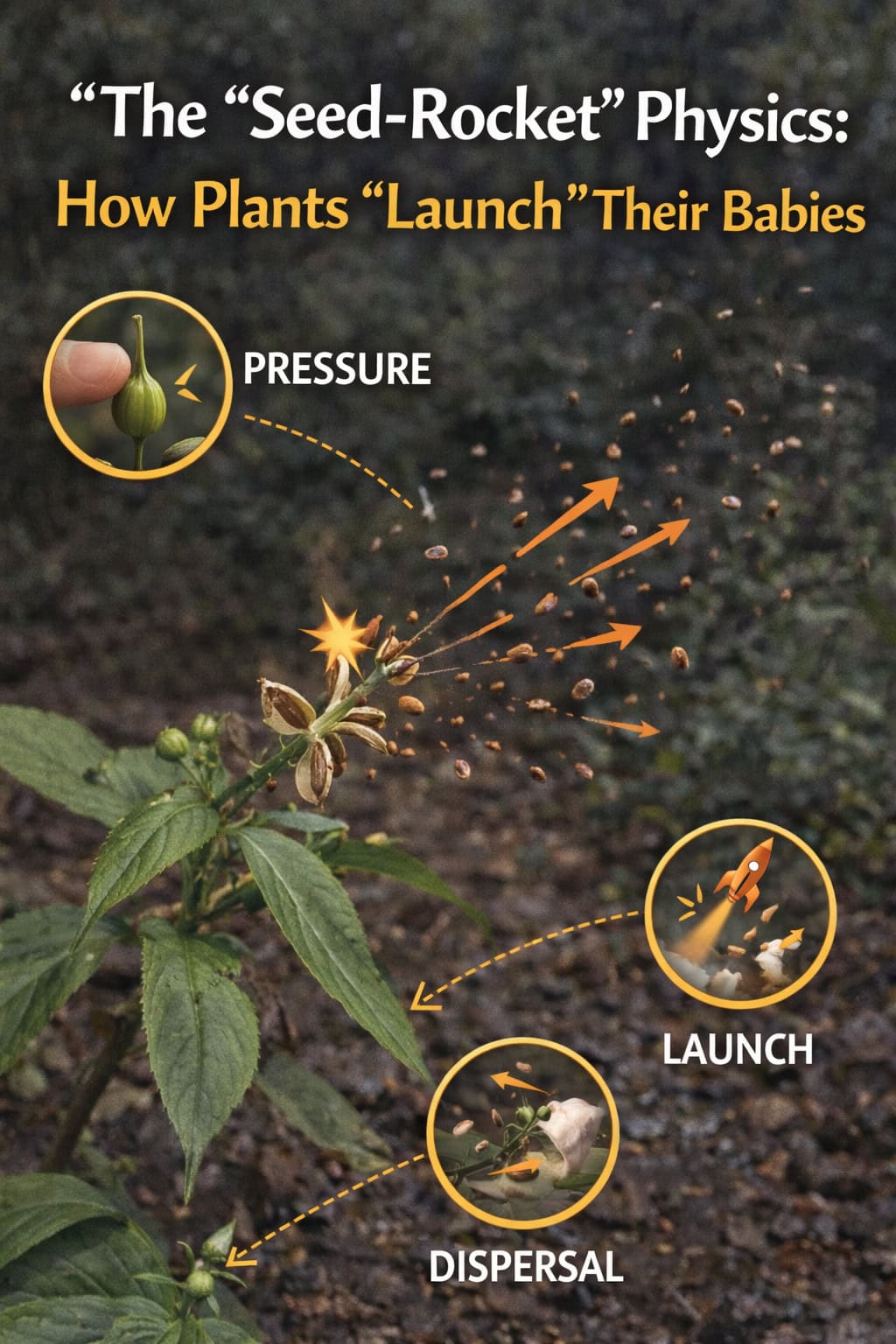
How Mother Nature Uses "Mechanical Springs" to Travel
If a plant just dropped its seeds straight down, the "babies" would have to compete with their "parents" for sunlight, water, and space. To survive, plants have to get their seeds as far away as possible. Some use the wind (like dandelions) and some use animals (like sticky burrs).
But the most high-tech plants use Explosive Dehiscence. They turn their seed pods into "Biological Rockets" that can launch seeds at incredible speeds. Here is the science of the Botanical Blast-Off.
1. The "Spring-Loaded" Secret (Potential Energy)
The Science: Plants don't have muscles, so they use Water Pressure (Turgor) and Drying to build up energy.
-
The Physics: As a seed pod dries out, the different layers of the pod shrink at different speeds. This creates Tension.
-
The Storage: The pod becomes like a "Cocking" a bow and arrow. It is storing Elastic Potential Energy. The more the pod dries, the more it wants to snap back to its original shape.
2. The "Touch-Me-Not" Trigger (Jewelweed)
The Science: Have you ever seen a small, green, bean-like pod on a plant near a creek, touched it, and watched it "explode" in your fingers? That’s Jewelweed.
-
The Engineering: The pod is made of five "valves" held under high tension. When you touch it, you break the delicate "Latch" holding them together.
-
The Physics: The valves coil up instantly like a snapped rubber band. This sudden movement transfers the energy to the seeds, flinging them up to 4 to 6 feet away in a fraction of a second!
3. The "Hura" Cannon (The Dynamite Tree)
The Science: In some tropical areas, there is a tree called the Hura crepitans. Its seed pods look like tiny pumpkins, but they are actually "Bio-Grenades."
-
The Velocity: When the pod dries out, it explodes with a sound like a pistol shot.
-
The Math: The seeds can be launched at speeds of over 160 miles per hour ($70\text{ m/s}$) and can land more than 150 feet away from the tree!
-
The Force: This is a perfect example of Newton’s Third Law: For every action (the pod snapping open), there is an equal and opposite reaction (the seed being launched forward).
4. The "Vetch" Spiral (The Curly-Cue Launch)
The Science: Some plants, like the Common Vetch or Wild Peas, use a "Double-Helix" design.
-
The Physics: The two halves of the seed pod are "programmed" to twist in opposite directions as they dry.
-
The Action: When the tension gets too high, the pod splits and the two halves curl up into spirals. This "Wringing" motion "spits" the seeds out like a wet watermelon seed squeezed between your fingers!
5. The "Seed-Rocket" Observation Lab
You can find these rockets right in your campsite:
-
The Hunt: Look for plants with pods that look "tight" or "twisted."
-
The Experiment: If you find a Jewelweed pod (look near damp, shady spots), place it in the palm of your hand and gently squeeze.
-
The Slow-Mo: If you have a phone with "Slow-Motion" video, try to film the explosion. You'll see that the seeds are launched before your brain even realizes the pod has moved!
Pro Tip: The "Water-Launch" Hack. Some plants, like the Squirting Cucumber, use internal water pressure instead of drying. They build up so much liquid inside the fruit that it eventually "blows the cork" (the stem) and squirts a jet of seeds and slime up to 20 feet!
Final Thoughts
Plants may seem like they are just sitting there, but they are actually master engineers. By using the simple physics of "Shrinking and Snapping," they can launch their next generation across the forest. The next time you hear a "pop" in the bushes, you might just be hearing a "Rocket Launch" in progress!
Watch the skies, Botanist!
🐟 Want to find a site near a "Botanical Launchpad"? Look for sites near creeks or meadow edges! CampgroundViews.com lets you take a 360-degree tour of the park. You can look for the lush, green "Habitat Zones" where plants like Jewelweed and Wild Peas love to grow, so you can set up your "Seed Lab" right at your picnic table.
Scout your "Launch Site" at CampgroundViews.com!