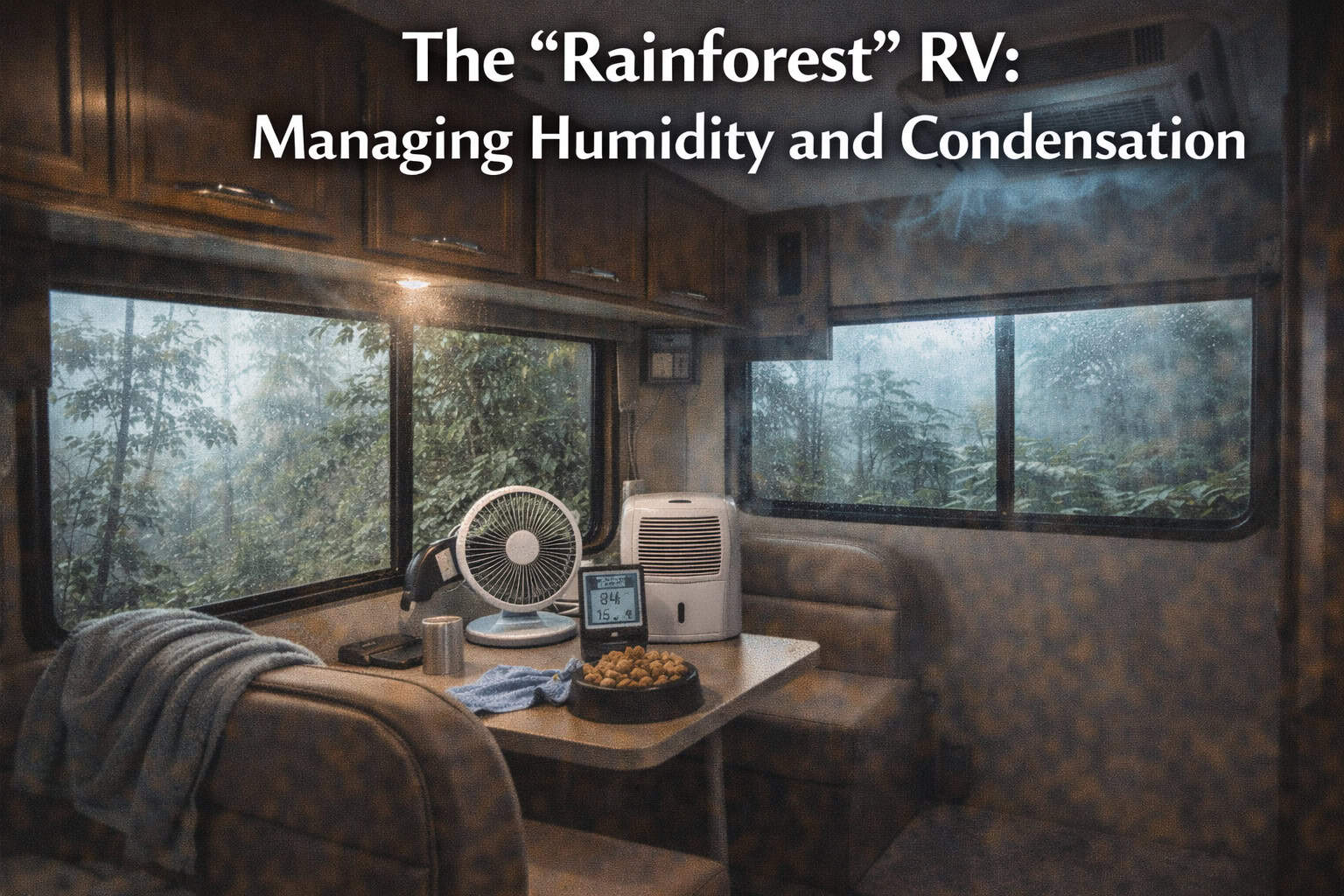
How to Stop Your Home on Wheels from Turning into a Swamp
Have you ever woken up in your RV bunk, looked at the window, and seen it covered in "tears"? Or maybe the walls feel a little bit chilly and damp to the touch? No, your RV isn't crying because the trip is ending—you’ve just created a Micro-Rainforest!
In a big house, humidity (water in the air) has plenty of room to spread out. In a tiny RV, that water has nowhere to go, so it sticks to the coldest things it can find: the windows and the metal frames. Here is the science of Condensation and how to keep your "Cabin" from becoming a "Canyon."
1. The "Human Steamer" Effect
The Science: Every time you breathe, you aren't just letting out air; you’re letting out Water Vapor.
-
The Math: One person exhales about one cup of water while they sleep! If there are four people and a dog in an RV, that is nearly a half-gallon of water floating in the air by morning.
-
The Problem: When that warm, wet breath hits a cold window, it turns back into liquid water. This is called the Dew Point.
-
The Fix: Even if it’s cold outside, keep a rooftop vent cracked open about an inch. This lets the "Wet Air" escape before it can turn into "Window Rain."
2. The "Pasta Steam" Volcano
The Science: Boiling a pot of water for mac-and-cheese is like setting off a humidity bomb in your kitchen.
-
The Physics: Hot air can hold way more water than cold air. When you cook, that steam fills the RV. As soon as the stove goes off and the air cools down, all that water has to "land" somewhere.
-
The Fix: Always turn on the Range Hood Fan before the water starts boiling. It’s like an exhaust pipe for your "Rainforest."
3. The "Cold Spot" Magnet
The Science: Water vapor is lazy. It looks for the coldest surface in the room to turn into liquid. In an RV, these are usually the Window Frames and the Corners of the Closets.
-
The Problem: If you keep your closet doors shut tight, the air inside stays cold and still. This is where "hidden puddles" form, which can make your clothes smell like a damp basement.
-
The Fix: Keep closet doors and cabinets cracked open just a tiny bit at night. This keeps the air moving so it stays the same temperature as the rest of the RV.
4. The "Dehumidifier" Hero
The Science: Sometimes, the air is just too wet (like if you’re camping near the beach or in the rain). You need a machine to "suck" the water out of the sky.
-
The Gear: A small Electric Dehumidifier or "DampRid" buckets (which use special crystals to catch water).
-
The Experiment: If you use a DampRid bucket, check it after three days. You’ll be shocked to see how many "cups" of water it caught just by sitting there!
5. The "Towel Dry" Mission
The Science: A wet towel hanging on a hook is basically a "Slow-Motion Fountain" adding water to your air for hours.
-
The Rule: If you take a shower or go swimming, never hang your wet towels inside the RV to dry.
-
The Fix: Hang them outside on a drying rack or the ladder. If it’s raining, put them in a plastic bin until you can get to a dryer. Keeping the "Wet Stuff" outside is the #1 way to keep the "Dry Stuff" dry.
Pro Tip: The "Window Insulation" Trick. If you’re camping in the winter, use "Reflectix" (that shiny, silver bubble wrap) to cover your windows at night. It acts as a barrier that keeps the warm air from touching the cold glass, stopping the "Rainforest" before it starts!
Final Thoughts
Managing humidity is one of the "Pro" skills of RVing. When you keep the air moving and the steam flowing out the vents, your RV stays cozy, your clothes stay fresh, and you won't wake up with a "rain shower" inside your bedroom.
Stay dry, Scientist!
🐟 Want to find a site with a breeze to help keep the humidity down? You can check the "Airflow" of your site before you arrive! CampgroundViews.com lets you take a 360-degree tour of the park. Look for sites that aren't tucked into a deep, "muggy" hollow and instead pick one with a little bit of elevation for that perfect, dry breeze.
Find your "High & Dry" site at CampgroundViews.com!