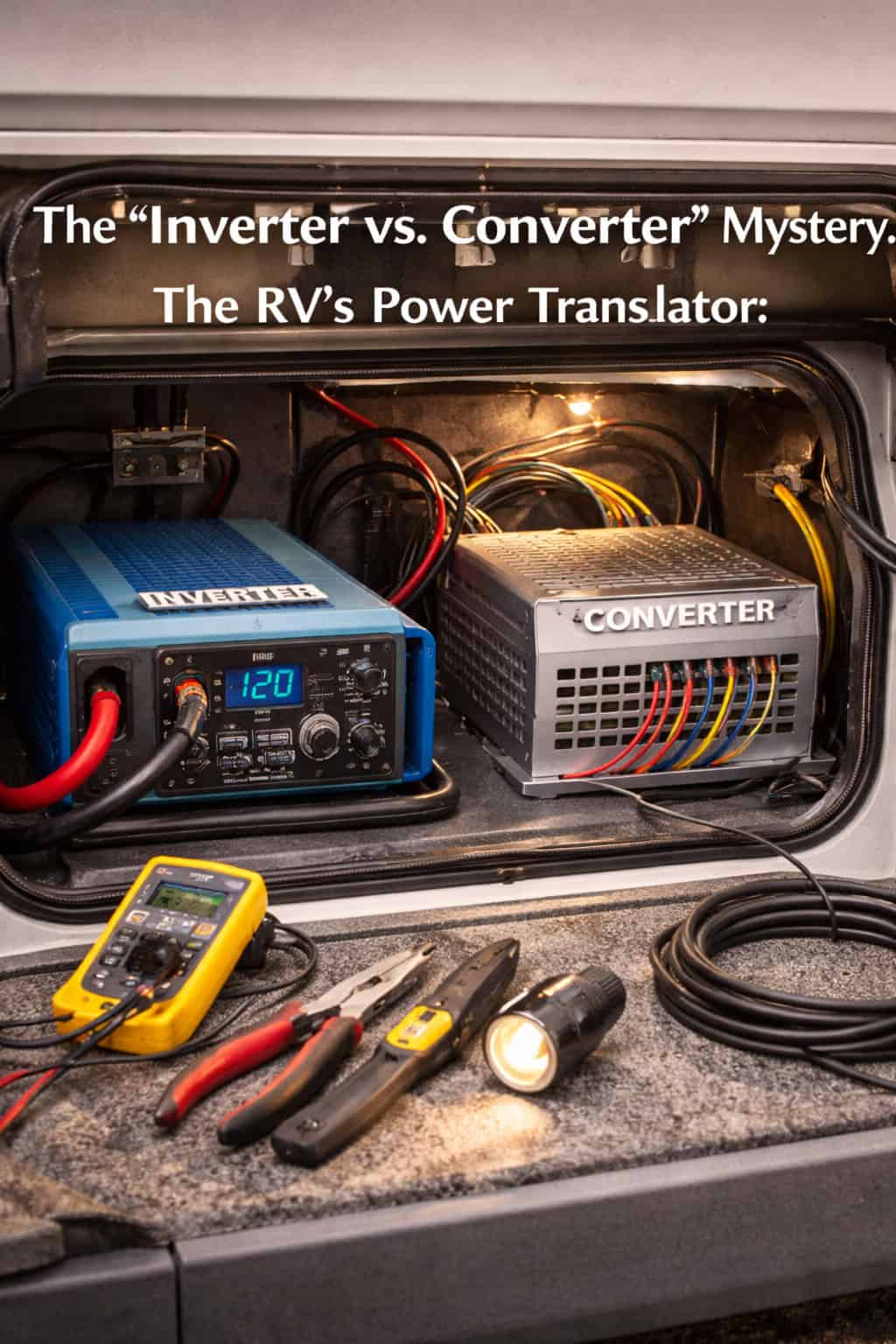
Solving the Secret of the "Energy Transformer"
In a regular house, you plug things into the wall and they just... work. But an RV is more complicated. It’s like a person who speaks two different languages at the same time. To keep the lights on and the tablet charged, the RV uses two "translators" called the Inverter and the Converter.
Most people get them mixed up, but as a Co-Captain, you need to know which is which so you can manage your "Power Budget" like a pro. Here is the breakdown of the RV’s electrical brain.
1. The Two Languages of Power
Before we meet the translators, you have to understand the two languages:
-
DC (Direct Current): This is "Battery Power" (12-Volt). It’s what runs your lights, the water pump, and the fans. It’s steady and simple, like water flowing through a garden hose.
-
AC (Alternating Current): This is "Shore Power" (120-Volt). It’s what comes out of the big plug at the campground. It’s powerful and "wiggles" back and forth. It runs big stuff like the microwave, the AC, and your hair dryer.
2. The Converter: The "Battery Charger"
The Direction: AC $\rightarrow$ DC
-
The Job: When you are plugged into the "Shore Power" at a campground, the Converter takes that big 120-Volt AC power and "steps it down" into 12-Volt DC power.
-
The Physics: It "converts" the power so it can fill up your RV batteries. Think of it as a giant phone charger for your whole house.
-
How you know it’s working: If your lights stay bright while you're plugged in and your batteries aren't dying, your Converter is doing its job!
3. The Inverter: The "Wall-Plug Maker"
The Direction: DC $\rightarrow$ AC
-
The Job: When you are "Boondocking" (not plugged in) and you want to use a regular wall outlet to watch TV or plug in a laptop, the Inverter has to work.
-
The Physics: It takes the 12-Volt battery power and "inverts" it, speeding it up and making it "wiggle" to create 120-Volt AC power.
-
The Warning: Inverters are energy hungry. It takes a lot of battery "juice" to make wall-plug power. If you leave the Inverter on all night, you might wake up with dead batteries!
4. The "Hum" Test
The Observation: Both of these machines generate heat when they work.
-
The Science: Because they are changing the state of electricity, some energy is lost as Thermal Energy (heat).
-
The Action: Look for a vent near your floor or under a cabinet. If you hear a tiny fan whirring or a low "hum," that’s the cooling fan keeping your Translator from getting too hot.
-
The Mission: Make sure you don't block those vents with your shoes or a backpack! They need to "breathe" to stay cool.
5. The "Inverter-Only" Outlets
The Mystery: Have you ever noticed that when you aren't plugged in, only some of the outlets in the RV work?
-
The Logic: Most RVs only connect the Inverter to one or two specific outlets (usually near the TV or the bed).
-
The Reason: This is to stop you from accidentally plugging in a toaster and draining your batteries in five minutes.
-
The Strategy: Learn which outlets are the "Inverter Outlets" so you know where to charge your gear when you're off-grid.
Pro Tip: The "Ghost Load." Even if nothing is plugged in, a turned-on Inverter "steals" a little bit of power just to stay ready. If you aren't using the TV or a laptop, flip the Inverter switch to OFF. It’s the easiest way to save your battery for the lights!
Final Thoughts
The Converter and Inverter are the unsung heroes of the RV. One keeps your batteries full, and the other lets you use your "home" gadgets in the middle of the wilderness. Once you understand the "AC/DC" dance, you’ll never be left in the dark!
Power on, Engineer!
🐟 Want to find a site with "Shore Power" so your Converter can do the work? You can filter for 30-amp or 50-amp sites! CampgroundViews.com lets you take a 360-degree tour of the park. You can see the power pedestal at every site to make sure it has exactly what your RV needs to stay charged.
Check your "Shore Power" at CampgroundViews.com!