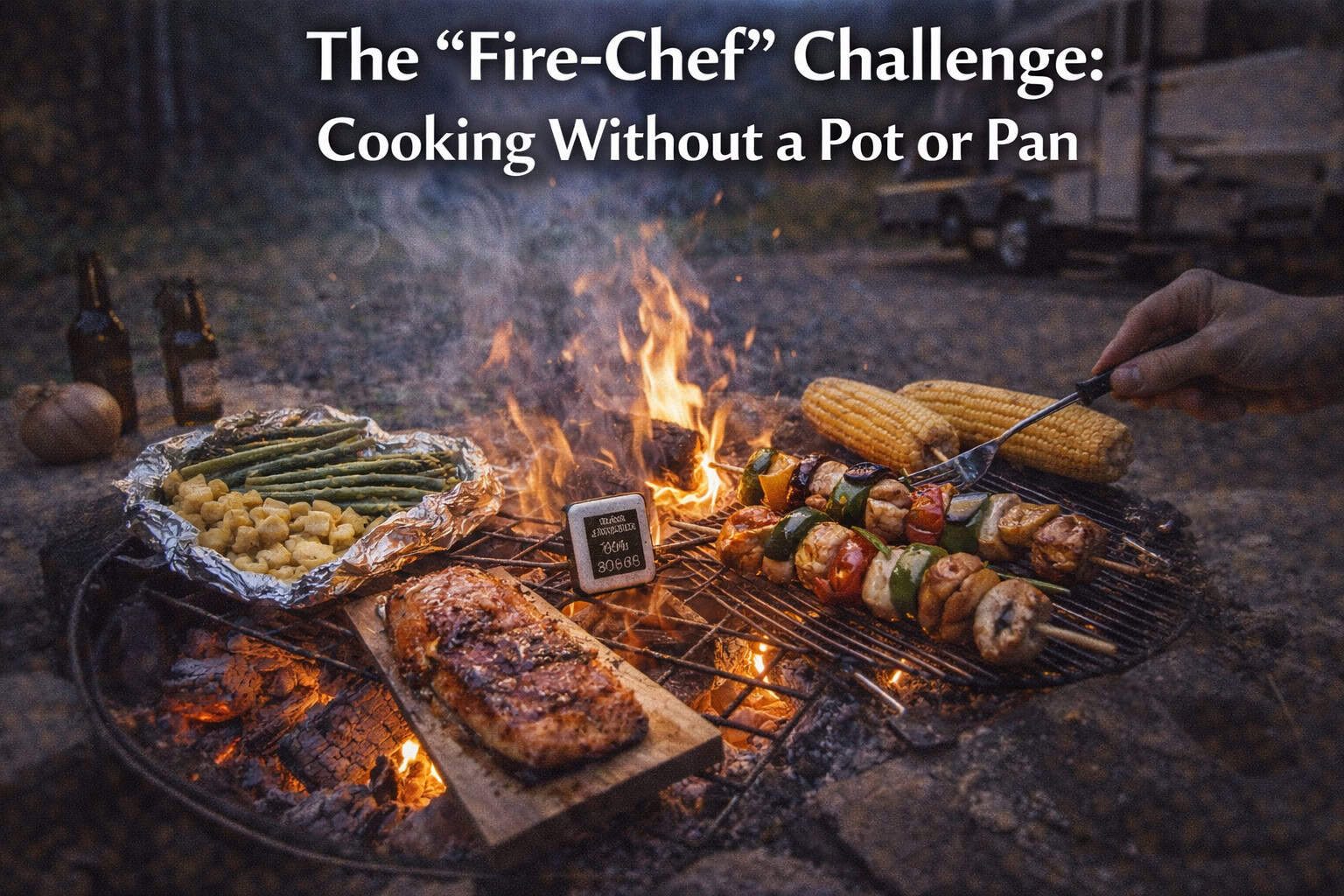
Extreme Culinary Science for the Stone-Age Gourmet
Imagine you’ve finally reached your secret camping spot, the fire is roaring, and you realize... you left the kitchen box back at the RV. No pans, no spatulas, no foil. In the city, this is a disaster. But for a Fire-Chef, this is where the fun begins!
Cooking without metal tools is a lesson in Conductive Heat and Natural Insulation. You aren't just making dinner; you’re using the Earth’s own materials to build a "Natural Oven." Here are four "Extreme Cooking" experiments to try on your next trip.
1. The "Citrus Oven" (Egg in an Orange)
The Science: An orange peel is full of moisture and essential oils. It can withstand the heat of the coals without burning through, acting like a tiny, aromatic Dutch Oven.
-
The Action: Cut an orange in half and eat the fruit (save the peel!). Crack an egg into the empty "cup" of the peel. Place the peel directly on a bed of glowing coals (not open flames).
-
The Result: The peel insulates the egg, cooking it gently while infusing it with a hint of citrus. When the egg white is solid, your breakfast is served!
2. The "Mud-Baked" Potato (The Earth Oven)
The Science: Wet mud acts as a perfect thermal barrier. It locks in moisture while allowing the high heat of the fire to bake the food inside.
-
The Action: Take a potato and coat it in a thick layer of wet, clay-like mud (about 1 inch thick). Bury it under the hot coals of your fire.
-
The Result: The mud dries into a hard shell (like a ceramic kiln). After about 45 minutes, crack open the "rock" to find a perfectly steamed, fluffy potato inside.
3. The "Flat Rock" Griddle
The Science: Dense stones like granite or slate are excellent at Thermal Retention. They soak up heat and hold it, creating a natural non-stick cooking surface.
-
The Action: Find a large, flat, DRY rock.
-
CRITICAL SAFETY NOTE: Never use rocks from a riverbed! Water trapped inside a river rock can turn to steam and cause the rock to explode when heated.
-
-
The Process: Prop the rock up over the coals using smaller stones. Once it’s hot enough that a drop of water "dances" on it, you can cook bacon, thin strips of steak, or even "Hoe Cakes" (flour and water dough) directly on the surface.
4. The "Ash-Roasted" Onion
The Science: Onions have multiple layers of "armor." The outer papery skins are designed to protect the inside.
-
The Action: Take a whole, unpeeled onion and toss it directly into the white ashes at the edge of the fire.
-
The Result: The outer layers will turn completely black and charred, but don't worry! That carbon layer protects the inside. After 20 minutes, peel away the burnt skin to find a sweet, caramelized, and "butter-soft" onion center.
5. The "Plank" Fish (Radiant Heat)
The Science: Instead of putting the food on the fire, you use Radiant Heat (heat moving through the air) to cook it slowly from the side.
-
The Action: Secure a piece of fish (or a flattened piece of dough) to a piece of "green" (wet) wood or a cedar plank. Prop the board up next to the fire so it "faces" the heat.
-
The Result: The food cooks slowly, picking up the smoky flavor of the wood without ever touching a flame.
Fire-Chef’s Pro Tip: The "Coal Bed" Secret. In all these experiments, the Flame is your enemy, and the Coals are your friends. Flames are unpredictable and too hot. Red-hot coals provide steady, even "Infrared" heat that gives you much better control over your "natural laboratory."
Final Thoughts
When you strip away the pots and pans, you connect with the way humans have cooked for thousands of years. It requires patience, observation, and a little bit of dirt on your hands—but the flavor of "Fire-Chef" food is something you can never replicate in a kitchen.
Class dismissed—let’s get cooking!
🐟 Want to find a site with a great fire ring for your experiments? Some fire pits are better for "Coal Beds" than others! CampgroundViews.com lets you take a 360-degree tour of the campsite. You can zoom in on the fire ring to see if it’s deep enough to hold the coals you need for your "Mud-Baked" potatoes.
Find your "Kitchen" at CampgroundViews.com!