Engineering a Survival System from a Plastic Bottle
Imagine you’re out on a long hike and you’ve run out of water. You find a nearby creek, but the water looks like chocolate milk—full of dirt, leaves, and tiny floaties. You know you can’t drink it as is, but you have an empty soda bottle in your pack.
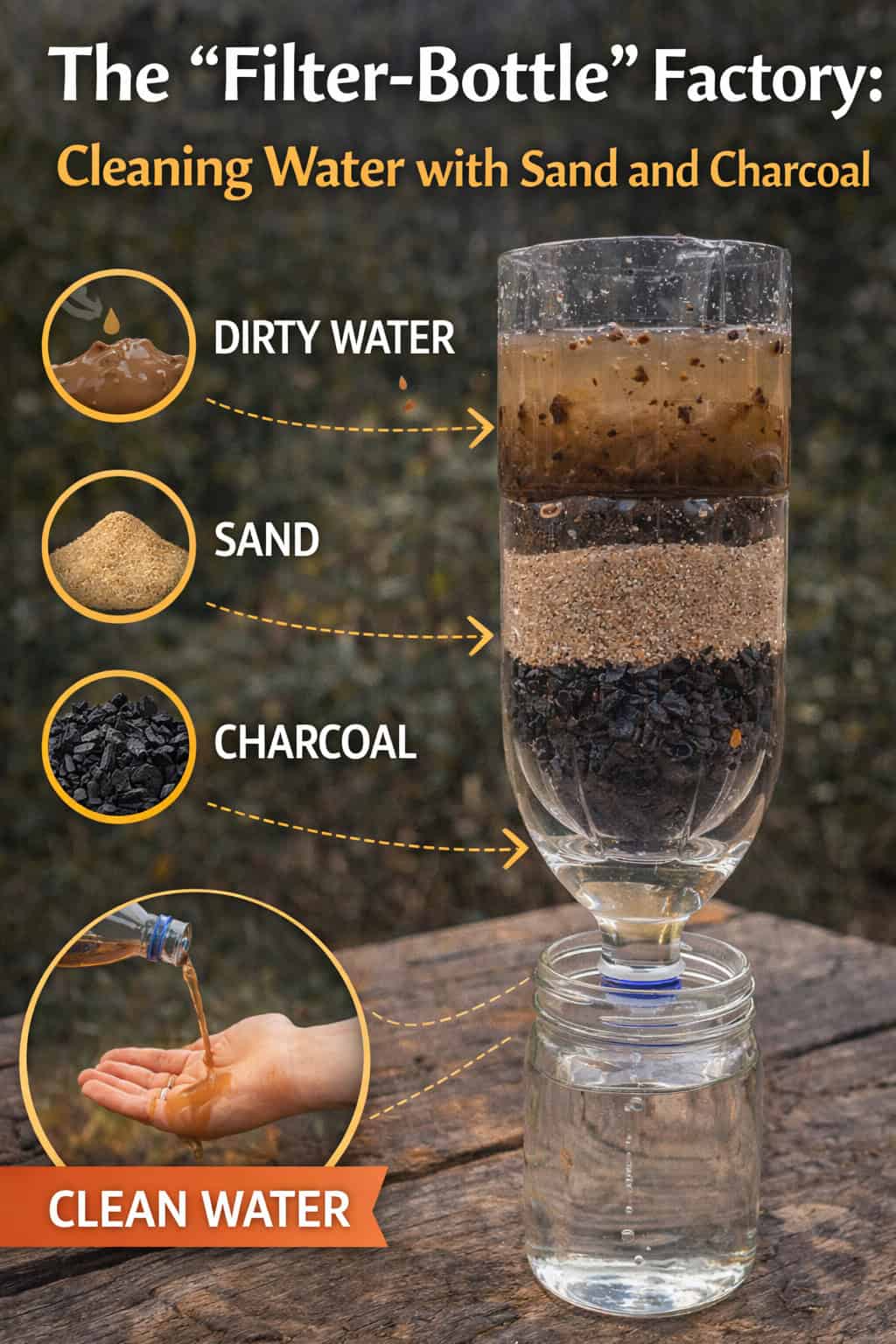
Congratulations! You have the main component of a Multi-Stage Gravity Filter. By using the principles of Porosity, Adsorption, and Sedimentation, you can turn that "muddy soup" into clear water. Here is how to build your own "Filter-Bottle" Factory.
1. The Anatomy of the Factory
The Concept: To clean water, we need to pass it through different "gates" that catch smaller and smaller pieces of debris.
-
The Physics: This is a Mechanical Filter. We are creating a "Physical Barrier" that allows the tiny water molecules through but traps the larger dirt particles.
-
The Build: Cut the bottom off your plastic bottle and turn it upside down (cap facing down). This is your "Filter Housing."
-
The Foundation: Place a piece of cloth (like a clean sock or a bandana) inside the neck of the bottle near the cap. This is the final "Safety Net" that keeps your filter materials from falling into your clean water cup.
2. Stage 1: The "Gravel" Pre-Filter
The Science: The top layer (the first thing the water hits) should be coarse gravel or small stones.
-
The Physics: This layer handles Coarse Filtration. It catches the big stuff—twigs, leaves, and large chunks of mud—so they don't clog up the finer layers below.
-
The Strategy: Think of this as the "Bouncer" at the door. It only lets the smaller "troublemakers" through.
3. Stage 2: The "Sand" Scrub
The Science: Under the gravel, you add a thick layer of fine sand.
-
The Physics: Sand has high Porosity (lots of tiny holes between the grains). As the water trickles through, the tiny grains of sand act like a "maze."
-
The Action: The dirt particles get stuck in the narrow gaps between the sand grains while the water winds its way through. This removes the "cloudiness" (Turbidity) from the water.
4. Stage 3: The "Charcoal" Magnet (The Secret Weapon)
The Science: This is the most important layer. You can use cooled-down charcoal from your campfire (crush it into small bits first!).
-
The Chemistry: Charcoal goes through a process called Adsorption (with a "d," not a "b").
-
The Physics: Charcoal is covered in millions of microscopic "hooks." These hooks "grab" onto chemicals, odors, and certain toxins as the water passes by. It doesn't just block them; it "sticks" them to the carbon.
-
The Result: This is why the water from your filter doesn't just look clear—it also tastes fresh and doesn't smell like a swamp!
5. The "Clear" vs. "Clean" Warning
The Science: This is the most important rule of the Filter Factory!
-
The Reality Check: Your filter is great at removing dirt, sand, and chemicals, but it is NOT small enough to catch microscopic Bacteria or Protozoa (the tiny germs that can make you sick).
-
The Safety Protocol: Even if the water comes out looking like crystal-clear bottled water, you MUST boil it for at least one minute before drinking it.
-
The Logic: The filter makes the water clear; the heat of the fire makes the water safe.
Pro Tip: The "Slow Flow" Rule. If the water is gushing out of your filter quickly, it’s not working! The slower the water move through the layers, the more time the charcoal has to "grab" the bad stuff. If it’s moving too fast, add more sand or pack the layers tighter.
Final Thoughts
Building a Filter-Bottle Factory is the ultimate test of an RV Co-Captain’s engineering skills. It teaches you that "waste" (like an empty bottle and campfire charcoal) can be turned into a life-saving tool. You'll never look at a muddy puddle the same way again!
Keep it flowing, Engineer!
🐟 Want to find a site near a "Water Lab" (a creek or lake)? You can scout for sites with easy water access for your experiments! CampgroundViews.com lets you take a 360-degree tour of the park. You can look at the trails leading to the water to make sure you have a perfect spot to gather your "Raw Materials" for the factory.
Find your "Waterfront Lab" at CampgroundViews.com!