Solving the Mystery of the Shape-Shifting Earth
Have you ever noticed that a campsite looks different after a heavy rain? Maybe there are new little "rivers" carved into the dirt, or a pile of sand appeared where it wasn’t before. You aren’t just looking at a muddy mess—you’re looking at Geomorphology in action!
Water is the most powerful "Architect" on Earth. It can move mountains, but it usually starts by moving the dirt right under your leveling jacks. As an Erosion Detective, your job is to spot the clues of how water is "stealing" the land and how we can stop it.
1. The "Splash Effect" (The First Strike)
The Science: Erosion doesn't start with a flood; it starts with a single raindrop.
-
The Physics: When a raindrop hits bare dirt, it acts like a tiny bomb. The force of the drop "blasts" the dirt particles apart and throws them into the air. This is called Splash Erosion.
-
The Clue: Look at the bottom of your RV or the legs of the picnic table. Do you see tiny mud splatters? That is the evidence of raindrops "shooting" dirt at your gear!
-
The Fix: This is why we like grass or pine needles. They act like a "Puffy Jacket" for the Earth, soaking up the hit so the dirt stays put.
2. The "Rill" Mystery (Mini-Grand Canyons)
The Science: As water starts to flow across your campsite, it follows the path of least resistance.
-
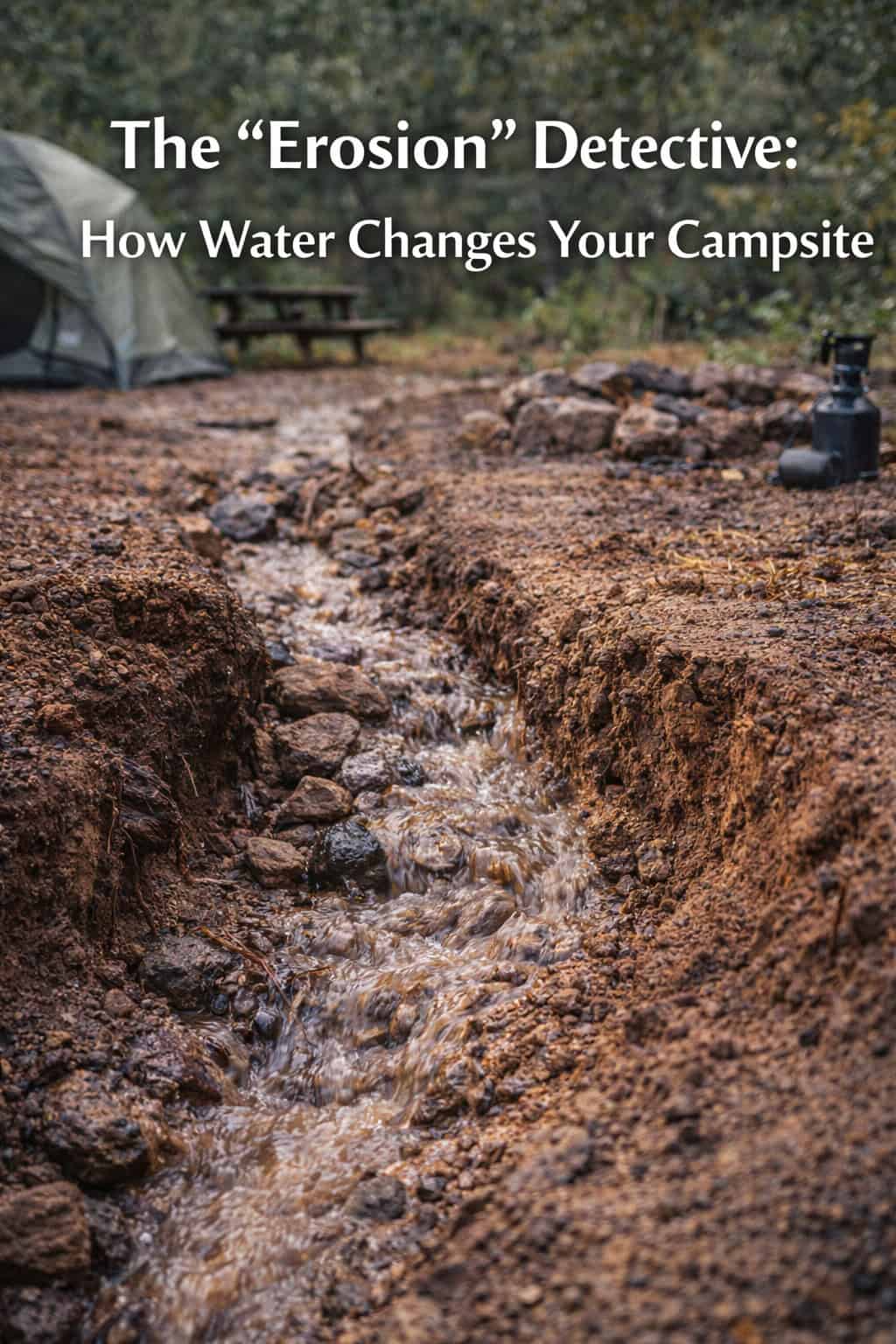
The Clue: Look for tiny, narrow channels in the dirt that look like miniature riverbeds. These are called Rills.
-
The Physics: Once a rill forms, the water flows faster because it's "channeled." Faster water has more Kinetic Energy, which means it can pick up bigger pieces of gravel and carry them away.
-
The Detective Goal: Follow the rill "Upstream." Can you find where the water started? Usually, it's a "drip line" from the RV roof or a steep slope in the site.
3. The "Delta" Deposit
The Science: When water moves fast, it carries dirt (Sediment). When water slows down, it "drops" its heavy load.
-
The Clue: Look for a fan-shaped pile of sand or silt at the bottom of a slope or where a "rill" hits a flat area. This is a Miniature Delta.
-
The Logic: This is the "Stolen Dirt" from the top of the site. It tells you exactly where the land is moving from (the high spot) to (the low spot).
4. The "Root Bridge" Observation
The Science: Trees are the "Super-Glue" of the campground.
-
The Clue: Have you ever seen a tree root that looks like a bridge, with all the dirt washed out from underneath it?
-
The Physics: The tree's roots are holding the dirt inside their "fingers," but the loose dirt around them has been carried away.
-
The Lesson: This tells you that without that tree, the whole hillside would have washed away a long time ago. Trees are the "Safety Anchors" for the campsite!
5. The "Detective’s Mission": Stop the Slide
As a Co-Captain, you can help protect the campground from "melting" away:
-
Stay on the Path: When you walk off the trail, you kill the grass. Dead grass = Bare dirt. Bare dirt = Splash Erosion!
-
Watch the Drip: If you see water pouring off your RV awning and carving a hole in the ground, move a rock or a piece of firewood under the drip. This "breaks" the fall of the water and saves the dirt.
-
The "Check-Dam" Experiment: Try building a tiny wall of pebbles across a "rill" (mini-canyon). Watch how it catches the sand and slows the water down!
Pro Tip: The "Hydrophobic" Soil Secret. Sometimes, after a very long dry spell or a forest fire, the dirt becomes "scared of water." It won't soak it up! The water just sits on top like a bead on a waxed car. This leads to Flash Flooding in the campsite because the water can't go "In," so it has to go "Down."
Final Thoughts
Erosion is a reminder that the Earth is never truly "finished." It is constantly being reshaped by the weather. When you learn to spot the "Splashes," "Rills," and "Deltas," you’re seeing the world the way a geologist does. You aren't just a camper; you're a witness to the power of nature!
Solve the mystery, save the soil!
🐟 Want to find a site that won't turn into a "River" when it rains? You want a site with good "Drainage" and a flat parking pad! CampgroundViews.com lets you take a 360-degree tour of the park. You can look at the "Slope" of each site and see if it’s covered in thick gravel (good for rain) or bare dirt (bad for rain).
Scout your "High Ground" at CampgroundViews.com!