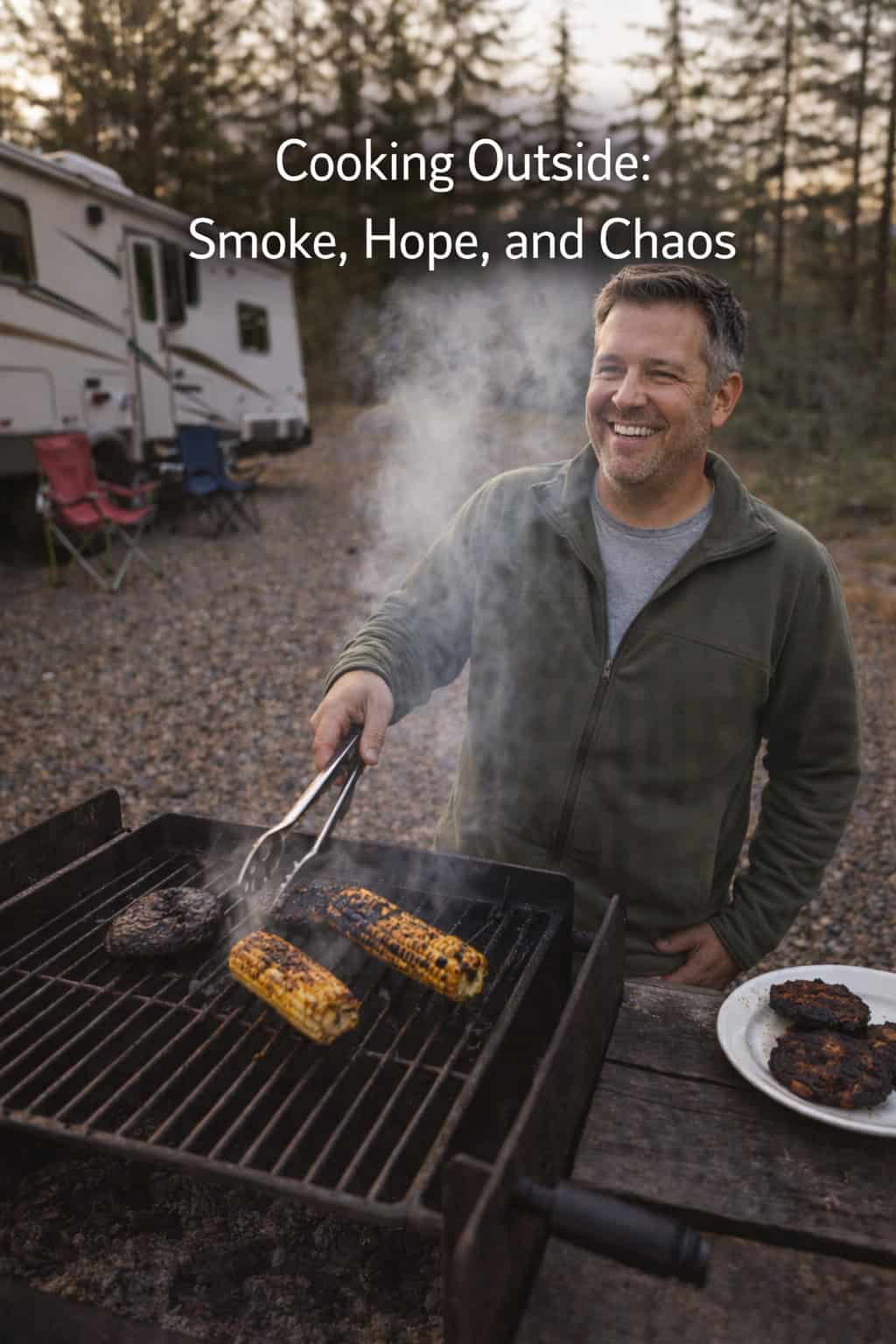
(Outdoor meals always sound easier than they are.)
Outdoor cooking is one of the great camping fantasies.
In your head, it looks like this:
-
A peaceful campsite
-
A sizzling grill
-
A perfect sunset
-
Everyone relaxed with a plate of something delicious
In reality?
It’s usually you, sweating over a camp stove, chasing a runaway paper towel, while the wind aggressively seasons everything with dirt.
Welcome to camp cooking.
It’s smoke, hope, and chaos — every single time.
The Plan Always Starts Strong
You arrive with confidence.
You brought the cooler.
You packed the ingredients.
You even remembered the spices.
You say something ambitious like:
“We’ll just cook outside tonight.”
That’s when camping hears you… and begins adjusting the conditions.
The Wind Immediately Gets Involved
Outdoor cooking would be much easier if the wind would mind its business.
But it never does.
The wind shows up like:
“Oh, you wanted a controlled flame? Interesting.”
Now you’re dealing with:
-
A stove that won’t stay lit
-
Napkins flying into the woods
-
Smoke moving with intention directly toward your face
Campfire smoke has one rule:
It will always find the person cooking.
Science cannot explain it. Camping can.
The Grill Is Hot. The Food Is Not
Camp cooking operates under strange laws of physics.
Somehow, everything is either:
-
Burnt on the outside
-
Frozen in the middle
-
Or cooked unevenly in a way that feels personal
Hot dogs become charcoal instantly.
Chicken takes 40 minutes longer than expected.
Vegetables fall through the grate like they yearn for freedom.
You stand there flipping things with the focus of a bomb technician.
You Forgot Something. You Always Forgot Something
No matter how prepared you are, camp cooking always includes a missing item.
Common sacrifices include:
-
The spatula
-
The lighter
-
The can opener
-
The seasoning you were excited about
-
The plate you swear you packed
At some point, you will use a weird substitute.
A spoon becomes a spatula.
A pocketknife becomes a can opener.
Camping builds innovation through inconvenience.
The Cleanup Is Worse Than the Cooking
Cooking outside is fun until you remember:
Dishes still exist.
Now you’re standing at a tiny campground spigot doing dishwashing gymnastics.
The water pressure is either:
-
A gentle mist
-
Or a firehose
The soap is sliding off the table.
A bug has joined the conversation.
And suddenly you understand why some campers eat sandwiches for three days straight.
The Moment It’s Worth It
And yet…
Somehow…
When it finally comes together — even imperfectly — it feels good.
You sit down with:
-
A slightly overcooked burger
-
Chips straight from the bag
-
A drink you earned emotionally
And you look around and think:
“Okay. This is camping.”
The food isn’t restaurant quality.
But the setting is unbeatable.
Camp Cooking Tips That Actually Help
If you want outdoor cooking to feel less like a survival exercise:
-
Prep ingredients ahead of time. Chop at home, not at the picnic table.
-
Bring one backup meal. Something no-cook for bad weather days.
-
Use foil packets. Minimal effort, minimal dishes.
-
Pack extra utensils. You will lose at least one.
-
Accept imperfection. Camp meals are about vibe, not Michelin stars.
Final Thoughts
Cooking outside is never as smooth as it sounds.
It’s smoky.
It’s chaotic.
It takes longer than planned.
But it’s also one of the most memorable parts of camping.
Because outdoor meals aren’t just food.
They’re stories.
They’re laughter.
They’re you standing at the grill thinking:
“This is burnt, but beautiful.”
🐟 Want to know what kind of cooking setup your campsite actually supports? Use Campground Views to preview site space, fire rules, and layout before you arrive — so dinner doesn’t become a surprise obstacle course.