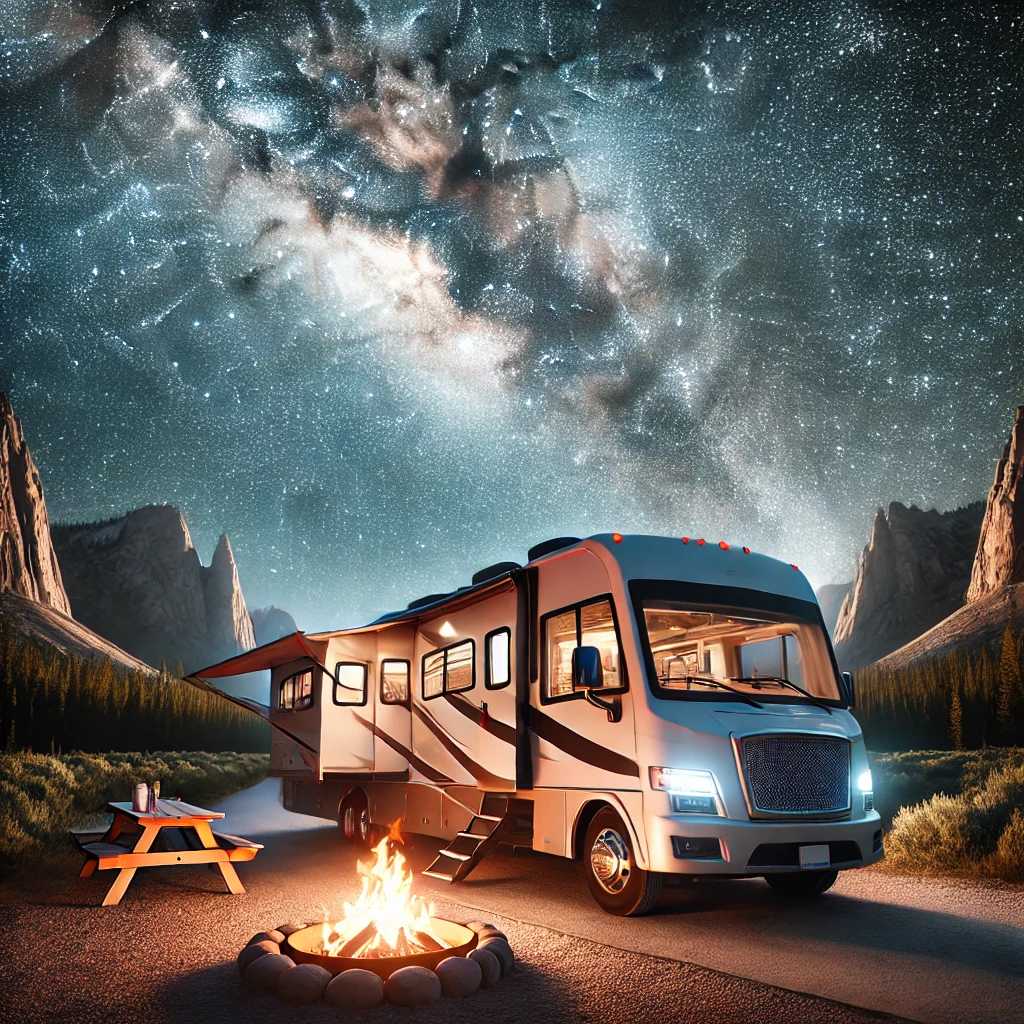
Experience the Night Sky Like Never Before
One of the best parts of RVing is the ability to escape the hustle and bustle of city life—and with it, the overwhelming glow of artificial lights. If you’ve ever parked in a dark-sky location, you know how magical a truly star-filled night can be.
Unfortunately, 80% of Americans can’t see the Milky Way from their backyard due to light pollution. But with the right planning, you can park your RV under some of the clearest, darkest skies in the country.
Here’s how to find the best stargazing spots, reduce your own light footprint, and fully immerse yourself in the cosmos.
🌌 Why Light Pollution is a Problem for Stargazers
Light pollution is caused by excessive artificial lighting, which washes out the night sky and makes it difficult to see stars, planets, and other celestial wonders.
🚫 The Downsides of Light Pollution:
❌ Fewer visible stars, making constellations harder to spot
❌ Interferes with night vision and reduces contrast in the sky
❌ Disrupts wildlife that depends on natural darkness
❌ Makes meteor showers, auroras, and the Milky Way harder to see
The good news? You don’t have to go far to escape city lights! With your RV, you can travel to some of the darkest places in the U.S. and experience the sky as our ancestors saw it.
📍 The Best RV-Friendly Dark Sky Locations in the U.S.
If you want epic stargazing with minimal light pollution, here are some of the best RV-accessible dark-sky destinations:
🏜 1. Big Bend National Park, Texas
🌌 Why Go? One of the darkest places in the U.S., perfect for seeing the Milky Way.
🚐 RV Camping: Rio Grande Village Campground & dispersed camping nearby.
🏕 2. Cherry Springs State Park, Pennsylvania
🌌 Why Go? Designated an International Dark Sky Park with 360-degree night sky views.
🚐 RV Camping: Cherry Springs State Park Campground (limited electric sites).
🏔 3. Great Basin National Park, Nevada
🌌 Why Go? High elevation and zero nearby cities make this one of the best stargazing parks in America.
🚐 RV Camping: Wheeler Peak Campground (smaller rigs) or Lower Lehman Creek (larger RVs).
🌄 4. Canyonlands National Park, Utah
🌌 Why Go? One of Utah’s darkest parks, offering incredible night sky photography.
🚐 RV Camping: Dead Horse Point State Park & Willow Flat Campground.
🏝 5. Outer Banks, North Carolina
🌌 Why Go? Camp right on the beach and enjoy a clear coastal sky with little light interference.
🚐 RV Camping: Cape Hatteras National Seashore Campgrounds.
🔎 How to Find Dark Sky Camping Spots
Even if you’re not visiting a national park, there are plenty of ways to find dark-sky locations near you.
🔭 Use These Tools:
✔ Dark Site Finder – Interactive map showing dark-sky locations.
✔ Light Pollution Map – Helps you find the darkest places near your route.
✔ International Dark-Sky Association (IDA) – List of certified Dark Sky Parks.
💡 How to Reduce Your Own Light Pollution at Camp
Even in a dark sky area, unnecessary campsite lighting can ruin the experience for you (and your neighbors).
🚐 RV Light Pollution Mistakes (and How to Fix Them)
❌ Leaving Exterior RV Lights On All Night → Use motion-activated or dimmable lights.
❌ Using Bright White Flashlights → Switch to red LED lights to protect night vision.
❌ Parking Too Close to Other Campers → If possible, pick isolated campsites away from artificial lights.
❌ Campfires That Are Too Big → Keep fires small to minimize glare.
🔦 Best Practice: Turn off all unnecessary lights after sunset and encourage fellow campers to do the same.
📷 How to Capture Stunning Night Sky Photos
Want to photograph the Milky Way, planets, or a meteor shower from your RV? Here’s how to get amazing shots.
📸 Camera Settings for Night Sky Photography
✔ Use a DSLR or mirrorless camera (smartphone cameras struggle in low light).
✔ Set ISO between 1600-3200 for bright stars.
✔ Use a wide aperture (f/2.8 or lower) for maximum light capture.
✔ Slow your shutter speed (15-30 seconds) to let in more light.
✔ Use a tripod to avoid blurry shots.
🚀 Best Celestial Events to See from an RV in 2025
Want to plan your RV trips around major space events? Mark your calendar for these:
🔴 March 13-14, 2025 – Total Lunar Eclipse (Visible across the U.S.)
🌎 March 29, 2025 – Partial Solar Eclipse (Best seen in the Northeast U.S.)
💫 August 11-13, 2025 – Perseid Meteor Shower (One of the year’s best meteor displays!)
🌕 October 7, November 5, December 4, 2025 – Supermoons (Larger and brighter full moons)
🚐 Plan a trip around these dates for the best celestial camping experience!
🏕 Final Thoughts: Trade City Lights for Starry Nights
RVing gives you the unique ability to escape light pollution and experience the true beauty of the night sky. Whether you’re boondocking in the desert or staying at a Dark Sky Park, the stars are waiting.
✔ Find a dark-sky campsite using maps and apps.
✔ Minimize artificial light at your campsite to enhance the experience.
✔ Plan trips around celestial events for the best stargazing.
🚐 Want to find the perfect dark-sky campground? Take a 360-degree virtual tour at CampgroundViews.com and see your next stargazing spot before you book!