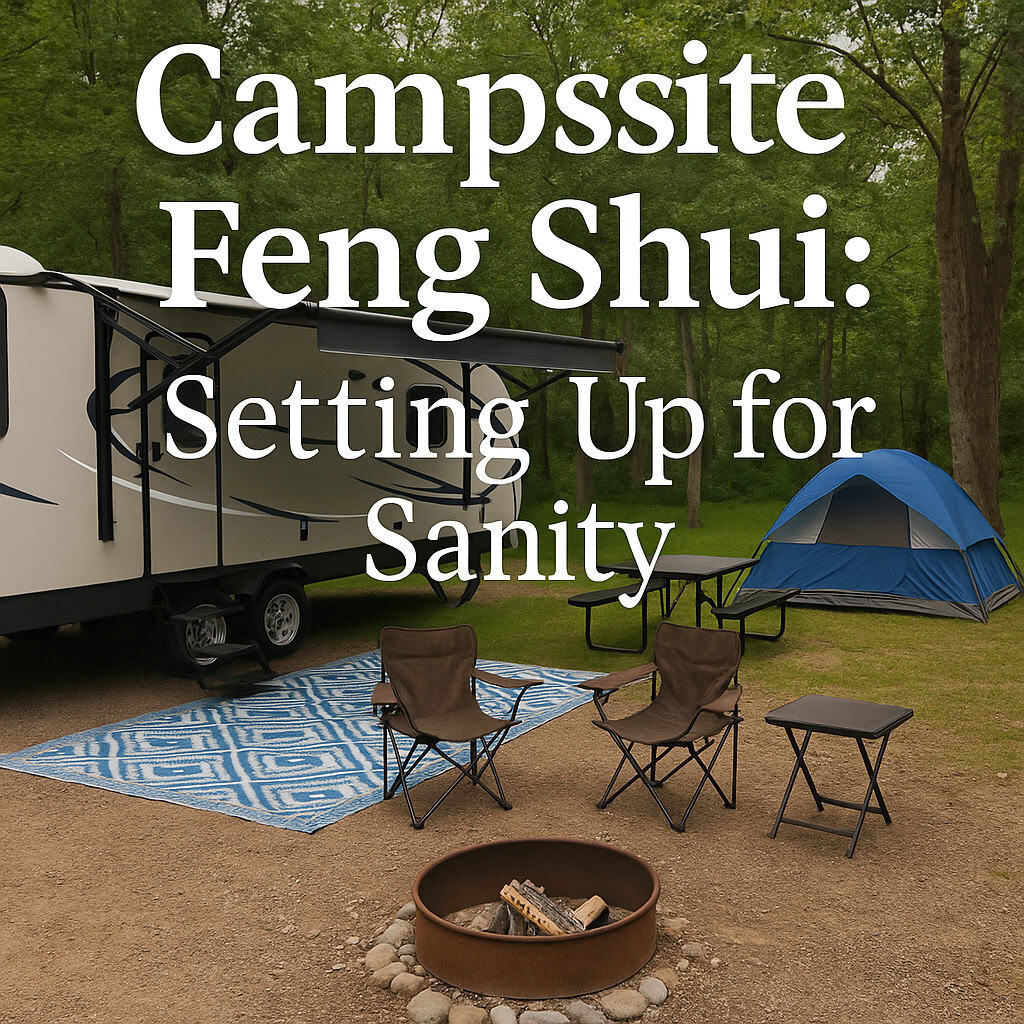
(Because your tent shouldn’t block your cooler. And your chair shouldn't face the dump station.)
You’ve arrived. You’ve parked. You’ve survived the leveling blocks.
Now what?
Now it’s time for campsite setup—and no, we’re not talking about military precision or influencer aesthetics. We’re talking about good ol’ camping comfort.
Feng Shui for campers means creating a flow that’s:
-
Functional
-
Chill
-
And not a tripping hazard by 8PM
Let’s build your perfect site—one tarp, chair, and lantern at a time.
🧭 1. Start with Your “Core Zone”
This is your home base—your shaded table, your fire pit, your place to sit, sip, and avoid direct sunlight on your sandwich.
Ask:
-
Where’s the flattest, driest ground?
-
Where does the sun hit in the afternoon?
-
Where won’t smoke from the fire blow directly into your tent/rig?
Position your chairs to face:
-
The fire
-
The view
-
Or your cooking area (so you can defend your snacks)
Avoid facing the bathroom path unless you enjoy waving to everyone walking past with a towel and flip-flops.
🏕 2. Tent/RV Placement: The Foundation of Your Flow
Tents:
-
Always pitch on level, high ground (wet sleep = bad sleep)
-
Keep the entrance facing away from foot traffic
-
Avoid blocking the main walkways with guy lines (unless you like being resented at 2AM)
RVs:
-
Position for optimal shade, door access, and hookups
-
Avoid parking too close to the table—no one wants to slide sideways into the picnic bench when exiting the rig
-
Make sure your outdoor rug isn’t flapping in the wind like an annoyed dragon
🍳 3. Build Your Kitchen Triangle
Think: prep, cook, clean—with minimal backtracking or ankle-stubbing.
Place:
-
Cooler and pantry bin close to prep space
-
Camp stove sheltered but ventilated
-
Trash bag hung or stashed nearby (but not where raccoons can RSVP)
And never, ever, put your dish station next to the tent. That’s just asking for a soap explosion and angry feet.
💡 4. Light It Right
Campsite lighting should be intentional—not a carnival.
Use:
-
Soft string lights for ambient glow
-
Headlamps and lanterns for tasks
-
Motion lights for safety (but not set to full strobe mode)
Position lights so they don’t beam straight into the neighbor’s site. Unless you’re trying to start a passive-aggressive light war. (Spoiler: You don’t want to.)
👟 5. Clear the Clutter Path
If you’ve got to step over a camp chair, dodge a cooler, and hop a tent peg just to reach the fire ring… you’ve got bad campsite juju.
Make sure:
-
Footpaths are wide and obvious (especially to the bathroom or rig door)
-
Shoes, bags, and gear have “parking spots”
-
The dog tie-out doesn’t wrap around the entire site like a tripwire
Pro tip: Use rugs, crates, or collapsible shelves to give everything a home. Cluttered camp = cluttered brain.
🐟 Want to Preview Before You Park?
Use CampgroundViews to scout your site layout before you arrive.
You’ll be able to:
-
See the slope and tree cover
-
Check distances to tables, fire pits, and pads
-
Plan your rig or tent position like a campsite feng shui master
Because showing up with a plan beats winging it in the rain with a crooked stove and no dry chair.
💬 Final Thoughts
Campsite feng shui isn’t about rules—it’s about flow.
The kind that makes your camp feel calm, efficient, and ready for anything.
Whether you’re staying one night or setting up for a full week, a thoughtful layout means fewer stubbed toes, less gear stress, and more actual relaxing.
And isn’t that the point?
🔗 Want to set up smarter, not harder?
Use CampgroundViews to preview your site before you book.
Because your gear deserves a good layout—and so do you.