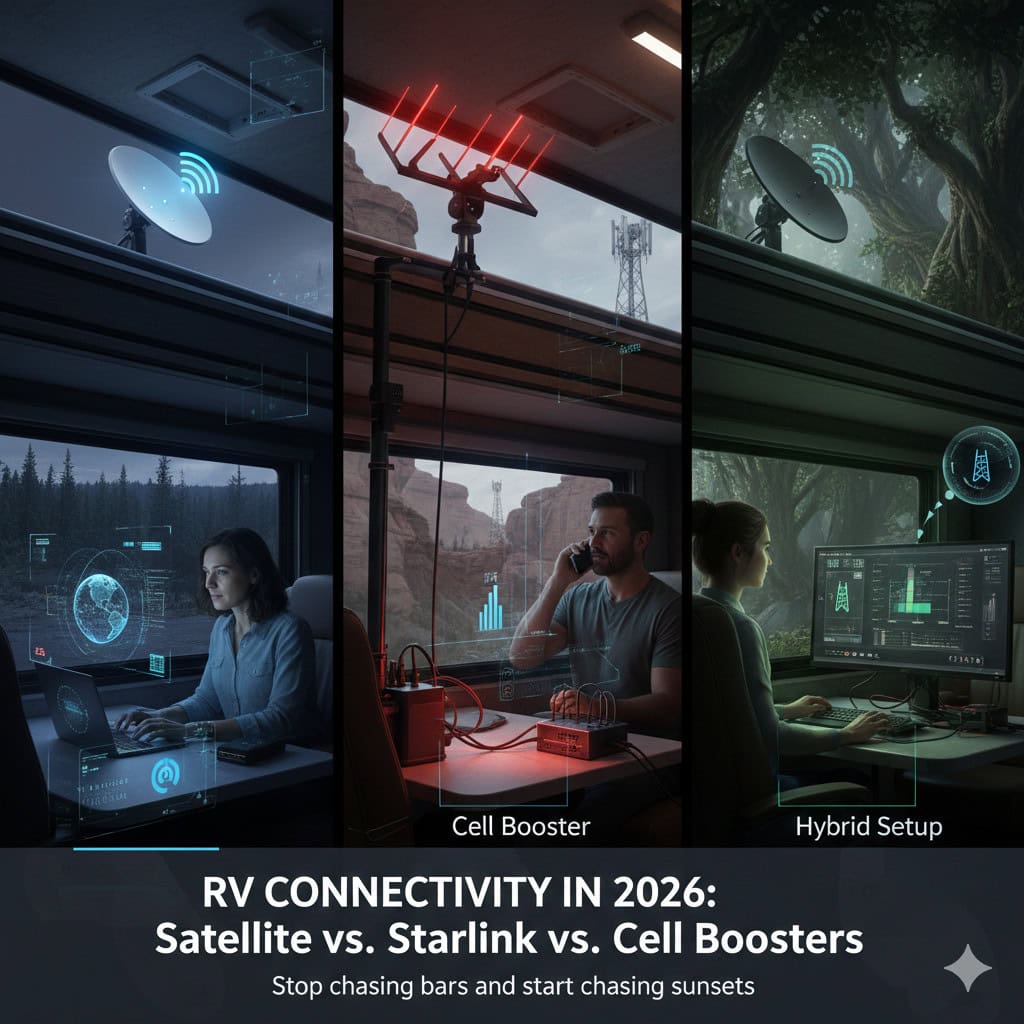
(Stop chasing bars and start chasing sunsets.)
It’s 2026, and the "Digital Nomad" dream has officially hit the mainstream. But as more people trade cubicles for campsites, the battle for bandwidth has intensified. Whether you're trying to lead a Zoom call from a National Forest or just stream a movie in a crowded RV park, the tech landscape has shifted.
The question isn't just "How do I get internet?" it's "Which flavor of connectivity fits my travel DNA?" Let's break down the 2026 heavy hitters.
1. Starlink: The "Everything, Everywhere" Heavyweight
In 2026, Starlink isn't just a niche tool; it’s the standard for off-grid reliability. With the rollout of the Starlink Mini and the Gigabit Performance Kit, the barrier to entry has never been lower (or faster).
-
The Vibe: Total freedom. If you can see the sky, you can work.
-
The 2026 Update: SpaceX now offers a tiered "Roam" system—a $50/month 100GB plan for casual weekenders and a $165/month Unlimited plan for the full-timers.
-
The Catch: It’s a power hog. While the new "Mini" is more efficient, running a dish still draws significant wattage, which matters if you're relying on solar. Plus, one thick pine tree can turn your 400 Mbps connection into a spinning wheel of death.
2. 5G Cell Boosters: The "Fringe" Specialist
Many RVers jumped to satellite and forgot about the humble booster. Big mistake. In 2026, 5G towers are everywhere, but their high-frequency signals struggle to penetrate RV aluminum walls.
-
The Vibe: The ultimate efficiency play.
-
The Hardware: Tools like the weBoost Drive Reach RV or the HiBoost Travel 3.0 take a single, unusable bar outside and turn it into stable LTE or 5G inside.
-
The Advantage: Unlike Starlink, boosters work while you are driving. They also use a fraction of the power (about 10W vs. Starlink’s 50W+). If you have any signal outside, a booster is often the more reliable, "always-on" choice for voice calls.
3. Traditional Satellite: The Legacy Backup
Providers like Viasat and HughesNet still exist, but they’ve pivoted.
-
The Vibe: The "I don't trust Musk" alternative.
-
The Reality: While they've improved latency, they still can't compete with the Low Earth Orbit (LEO) speeds of Starlink. In 2026, these are primarily used as fixed-location backups for seasonal campers who stay in one spot for six months.
The 2026 Pro Strategy: The "Dual-Path" Setup
The most successful remote workers in 2026 don't pick just one. They use a Hybrid Setup.
Key Tip: Run a 5G router with a booster as your primary "always-on" connection for low power draw and stability. Deploy Starlink only when you hit the "dead zones" or need high-bandwidth for video rendering and gaming.
Which One is You?
| If You Are... | Your Best Bet |
| The Weekend Warrior | A high-end 5G Hotspot + a Signal Booster. Simple, cheap, and effective for 90% of campgrounds. |
| The Off-Grid Boondocker | Starlink Roam. You need the satellites because the towers don't know you exist. |
| The Executive Nomad | The Hybrid. Starlink for the data, Booster for the "can't-drop-this" phone calls. |
Final Thoughts
Connectivity in 2026 is no longer about finding a signal; it’s about managing your Power vs. Performance. If you’re parked under a canopy of ancient oaks, your $2,000 Starlink dish is a paperweight, but your cell booster might just save your workday.
🐟 Want to know if your dream site is a "connectivity trap"? Before you commit to a week of remote work, use CampgroundViews.com. Our 360-degree tours let you look up—literally. See if there are tree obstructions that will block your Starlink or if you’re tucked in a canyon that kills cell service.
Verify your "office view" at CampgroundViews.com and stay connected where it counts!