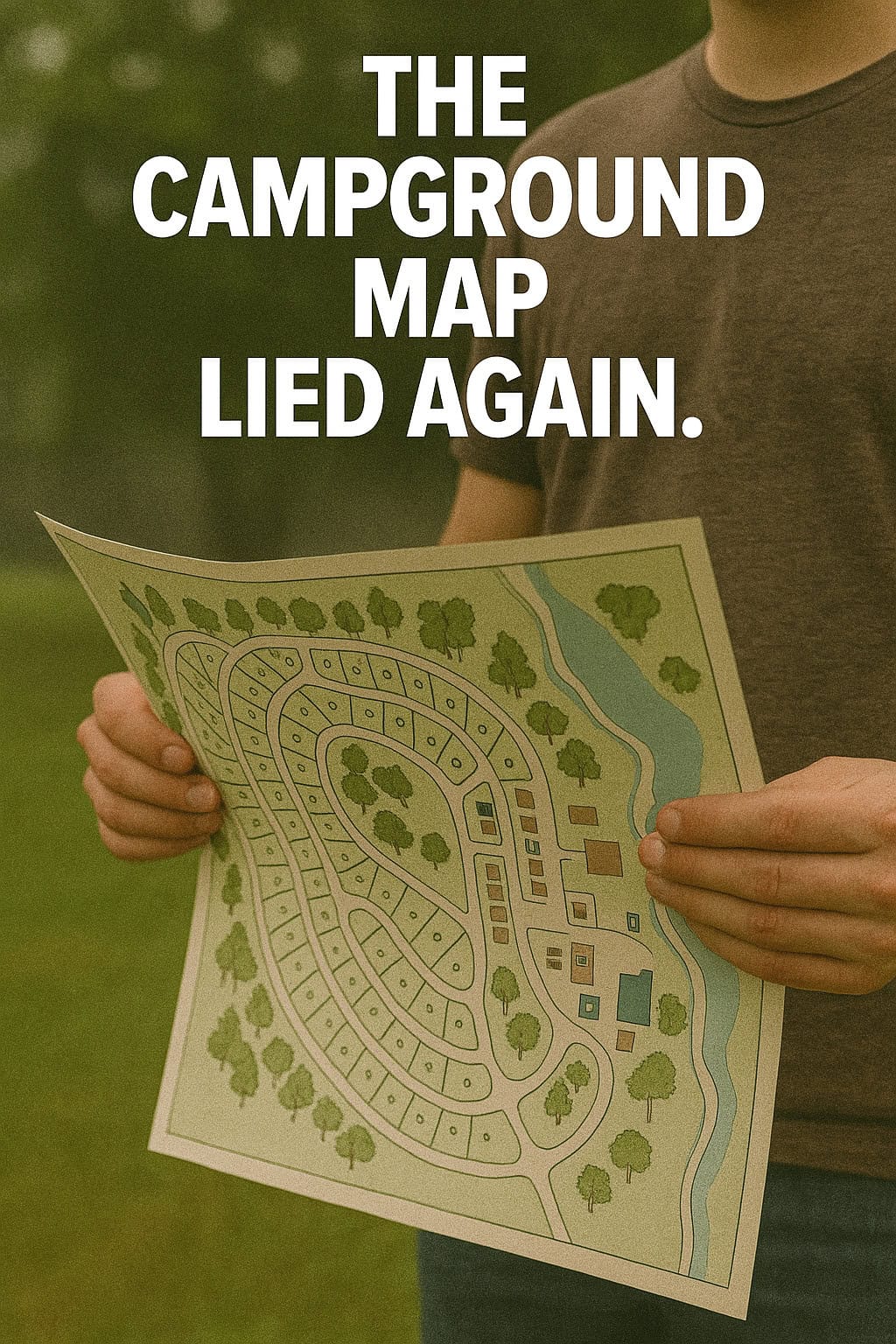
(Because “short walk” is never a short walk.)
You study the campground map like it’s going to protect you.
You pick your site based on logic.
You even do the little finger-trace route from your pad to the bathroom like a responsible adult.
And then you arrive.
Suddenly:
-
“near the facilities” means “a scenic hike”
-
“easy access” means “three turns and a surprise hill”
-
and the “dump station” is apparently in a different time zone
The campground map lied again. Or—more accurately—it told the truth in a way that’s wildly unhelpful in real life.
Here’s why it happens, and how to stop getting played.
🗺 1. Maps Are Not to Scale (And They Know It)
Campground maps love vibes. They hate accuracy.
They’ll show:
-
a cute little loop
-
a tiny icon for the bathroom
-
a cheerful “trail” line
What they don’t show:
-
distance
-
elevation
-
the fact that the path is basically sand
-
or that you’ll be carrying a toddler and a torch at 2 a.m.
A map can be “correct” and still be a full betrayal.
🧭 2. “Close To” Is a Marketing Term
“Close to the lake” = you can technically see water through four trees and your neighbor's fifth wheel.
“Close to the showers” = you will hear doors slamming.
“Close to the playground” = you will hear joy at 7 a.m. sharp.
Close is relative. Regret is universal.
🌲 3. The Map Doesn’t Show the Real Obstacles
The map never includes:
-
the tree that blocks your slide
-
the post right where you need to turn
-
the branch that scrapes your roof
-
the uneven dip that makes your rig lean emotionally
The map shows you a neat rectangle called “Site 42.”
It does not show you Site 42’s personality.
🧗 4. Elevation Is Always a Surprise
The map says it’s two minutes away.
Reality:
-
it’s uphill both ways
-
the gravel is loose
-
and your flip-flops are losing the will to live
Campground maps don’t acknowledge slope.
They just suggest you teleport.
🚶 5. The “Short Cut” Is Never What You Think
The dotted line on the map looks helpful. It’s not.
Shortcuts often mean:
-
narrow path
-
overgrown weeds
-
mud after rain
-
a gate that is mysteriously locked
-
or a route that definitely wasn’t meant for night-time bathroom trips
If it’s dotted, assume it’s emotional.
🚐 6. One-Way Roads Are Where Plans Go to Die
You pull in thinking, “We’ll just loop around.”
Then you discover:
-
one-way arrows
-
tight turns
-
lanes designed for golf carts
-
and a sudden “NO RVs” sign you’re already past
Now you’re committed to a route you didn’t choose, guided by panic and mirrors.
📵 7. The Map Also Assumes You Have Signal (Cute)
You try to cross-check with GPS.
No service.
No loading.
Just your screen spinning and your confidence collapsing.
So now you’re navigating using:
-
the map
-
instinct
-
and the universal camping method: “Follow that other RV and hope.”
✅ 8. How to Stop Getting Played by Campground Maps
Here’s the practical fix that works:
Before arrival:
-
look up satellite view if you can
-
read reviews for “tight turns,” “long walk,” “no shade,” etc.
-
have a backup site preference in mind
On arrival:
-
do a quick drive-through if possible
-
walk the site before committing
-
confirm where facilities actually are in real distance, not map distance
And always assume: “Near” is a suggestion.
💬 Final Thoughts
Campground maps are like those “serving suggestion” photos on food packages.
Technically related to reality.
But not a guarantee of anything.
So yes, the map lied again.
But now you know how to read between the lines: check the terrain, verify the distance, and never trust a dotted shortcut after dark.
🐟 Want to know what you’re actually pulling into before you arrive? Use Campground Views to preview campground layout, site spacing, road access, and general setup realities—so the map doesn’t get the last laugh.
🔗 Follow us for more RV life truths, campsite sanity tips, and humor for people who’ve absolutely said, “This is not where the bathroom was on the map.”