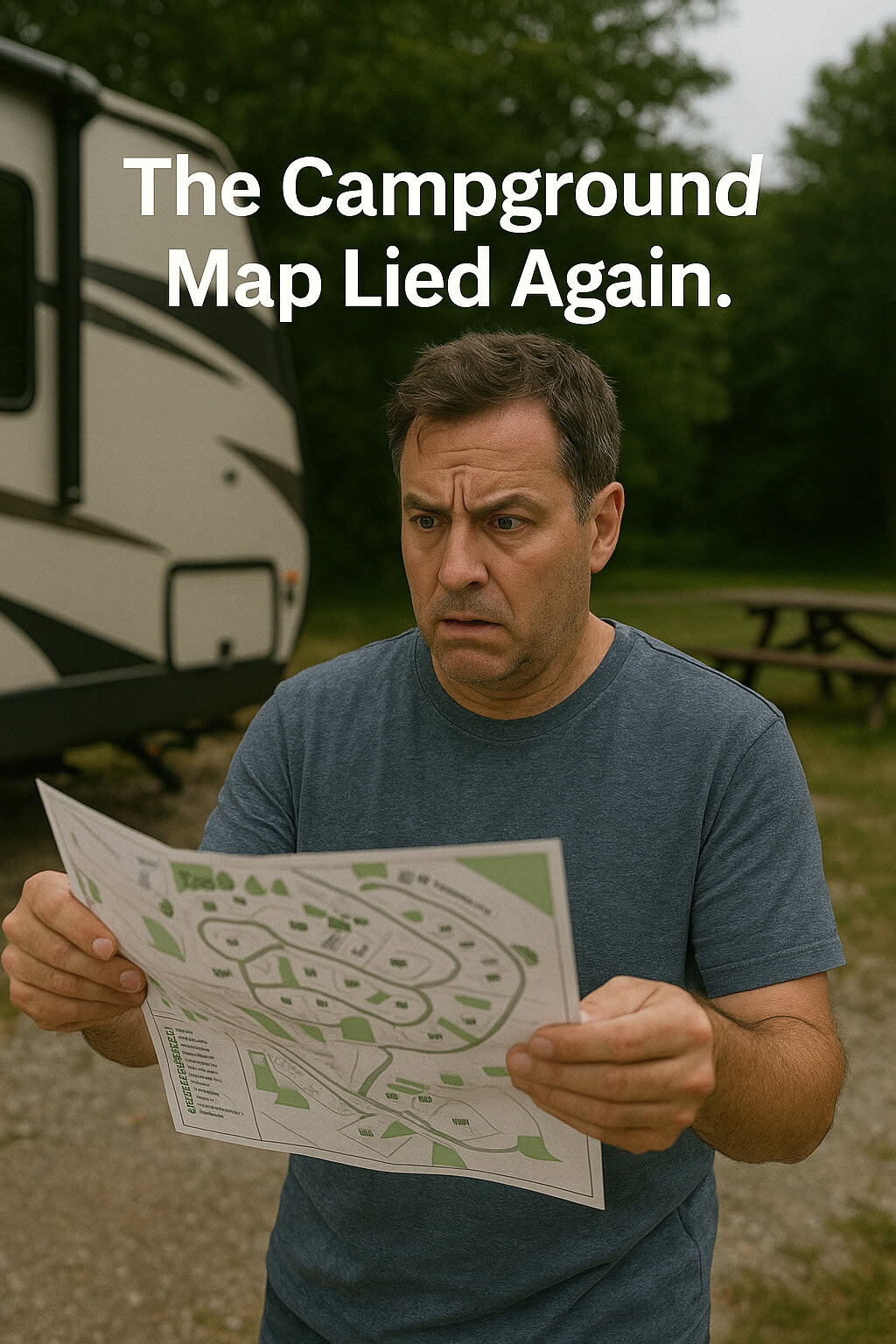
(Because “spacious pull-through” is sometimes a work of fiction.)
You did everything right. You booked early. You studied the campground map like it was a treasure hunt. You even picked a site that looked perfect: easy turn-in, lots of space, “close to amenities but still private.”
And then you arrive.
Site 14 is shaped like a triangle. The “pull-through” requires a three-point turn and a prayer. The neighbor's picnic table is basically in your slide path. And the “waterfront view” is technically true… if you stand on your bumper and squint through three bushes.
Welcome back to the classic RV experience: the campground map lied again.
🗺️ 1. “Pull-Through” Doesn’t Always Mean “Easy”
Some parks call it a pull-through because you can technically exit without backing up—if you:
-
have a short rig
-
don’t mind tight turns
-
and enjoy mild stress
Reality check: the loop road angle matters more than the label.
📏 2. “Site Length” Is a Fantasy Number
Many sites list length like it’s a clean rectangle.
But on arrival you discover:
-
the usable pad is shorter than the listed number
-
the front half is sloped
-
the back half is blocked by a boulder placed by someone who hates happiness
Translation: you can fit your rig… if you park diagonally like modern art.
🌲 3. The Trees Were Not Mentioned (For Legal Reasons)
Campground maps love little cute icons.
They do not accurately represent:
-
low branches exactly at A/C height
-
that one trunk perfectly positioned to block your slide
-
the “shade” that is actually “branch-to-roof contact”
If your map has a tree icon, assume it’s hiding a boss-level obstacle.
🚽 4. “Near the Bathhouse” Is a Double-Edged Sword
Sounds convenient until you realize it also means:
-
foot traffic all day
-
headlights at night
-
and the late-evening slam of the door that echoes through your soul
Sometimes “close” is code for “busy.”
⚡ 5. The Hookups Are Never Where You Want Them
Nothing builds character like discovering the power pedestal is:
-
behind your rig
-
on the wrong side
-
exactly 6 inches too far for your cord
-
and angled like it’s trying not to make eye contact
Same goes for water spigots. They’re always positioned for the RV that isn’t yours.
🧱 6. The Pad Is Either a Tilted Driveway or Soft Sand
Maps rarely mention the fun stuff:
-
a slope that turns levelling into a full event
-
gravel that slides under blocks
-
sand that looks fine until your stabilizers sink like they’re trying to escape
And of course, the moment you get it perfect—someone walks by and says, “Oof. Unlevel site, huh?”
🧠 7. The Real Problem Isn’t the Map. It’s the Lack of Context.
A flat, simple map can’t show you:
-
how tight the road feels with a toad
-
whether the pad is crowned or rutted
-
where the trees actually sit
-
how close you are to neighbors, dumpsters, or the playground chaos zone
That’s why we keep getting surprised.
💬 Final Thoughts
Campground maps aren’t useless… they’re just optimistic. Like a menu photo. Like a gym membership. Like “quick 5-minute setup.”
So yes—trust the map. But verify with real context whenever you can. Your slides, your sanity, and your marriage will thank you.
🐟 Want to stop getting catfished by campground maps? Use Campground Views to preview site layouts, spacing, slope, and approach before you book—so you know what you’re actually pulling into (not what the map hopes you’ll imagine).