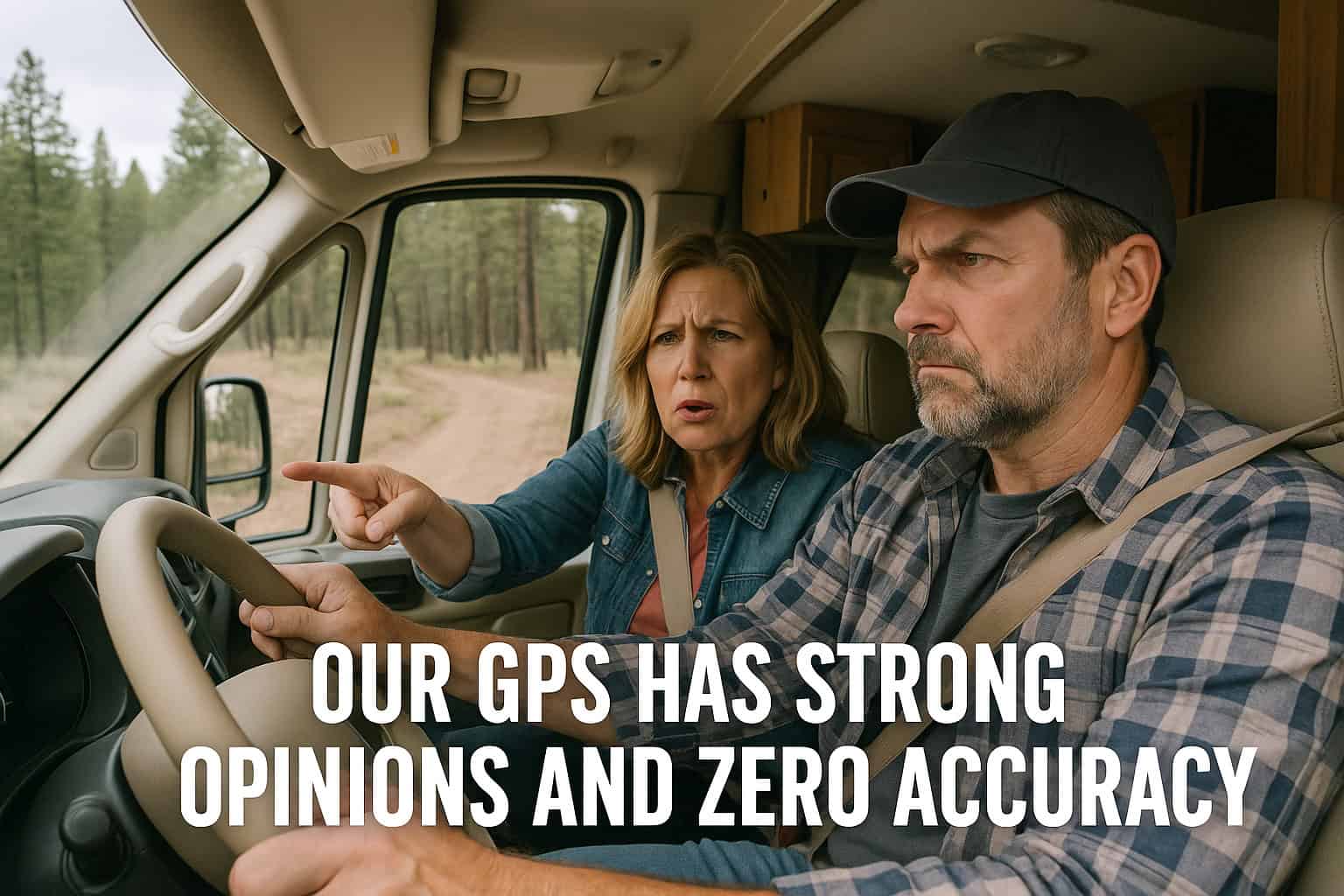
Because the only thing more confident than your navigation app is how wrong it usually is.
🗺️ The Problem with Overconfidence
GPS never says “maybe.” It always says:
-
Turn left now (into a cornfield).
-
Continue straight (into a lake).
-
Arrived at your destination (random barn, not the campground).
It’s bold. It’s sure. And it’s frequently lying.
🚐 1. The Height Problem
Your rig is not a sedan. Yet your GPS insists you’ll “fit just fine” under that 10-foot bridge. Spoiler: you won’t. Unless you enjoy making expensive roof skylights, always double-check with RV-specific maps.
🌲 2. The “Scenic Route” Scam
Scenic route sounds lovely until you’re inching along a mountain road with no guardrail, three hairpin turns, and a line of locals glaring at your brake lights. Sometimes “fastest route” is just code for “adventure you didn’t want.”
🧭 3. The Last-Mile Betrayal
GPS is decent on highways. But the closer you get to the campground, the worse it gets. Suddenly, it’s leading you through neighborhood cul-de-sacs or down dirt roads better suited for goats than trailers.
😂 4. How to Outsmart the Liar in Your Dashboard
-
Cross-check directions with campground websites (they know the safe roads).
-
Use RV-friendly apps that factor in height, weight, and propane restrictions.
-
Trust actual signs more than the voice in your dash. If a sign says “No RVs”—believe it.
❤️ Final Thoughts
GPS is like that overconfident friend who never admits they’re wrong. It’ll get you close—but you’ll need your own judgment (and maybe a paper map) to actually get there in one piece.
So the next time your GPS tells you to “turn here,” pause and ask: “Do I trust this? Or do I trust my roof clearance?”
🐟 Want one less navigation surprise?
Preview campground roads, entrances, and approaches with Campground Views. It’s the closest thing to GPS that actually tells the truth.