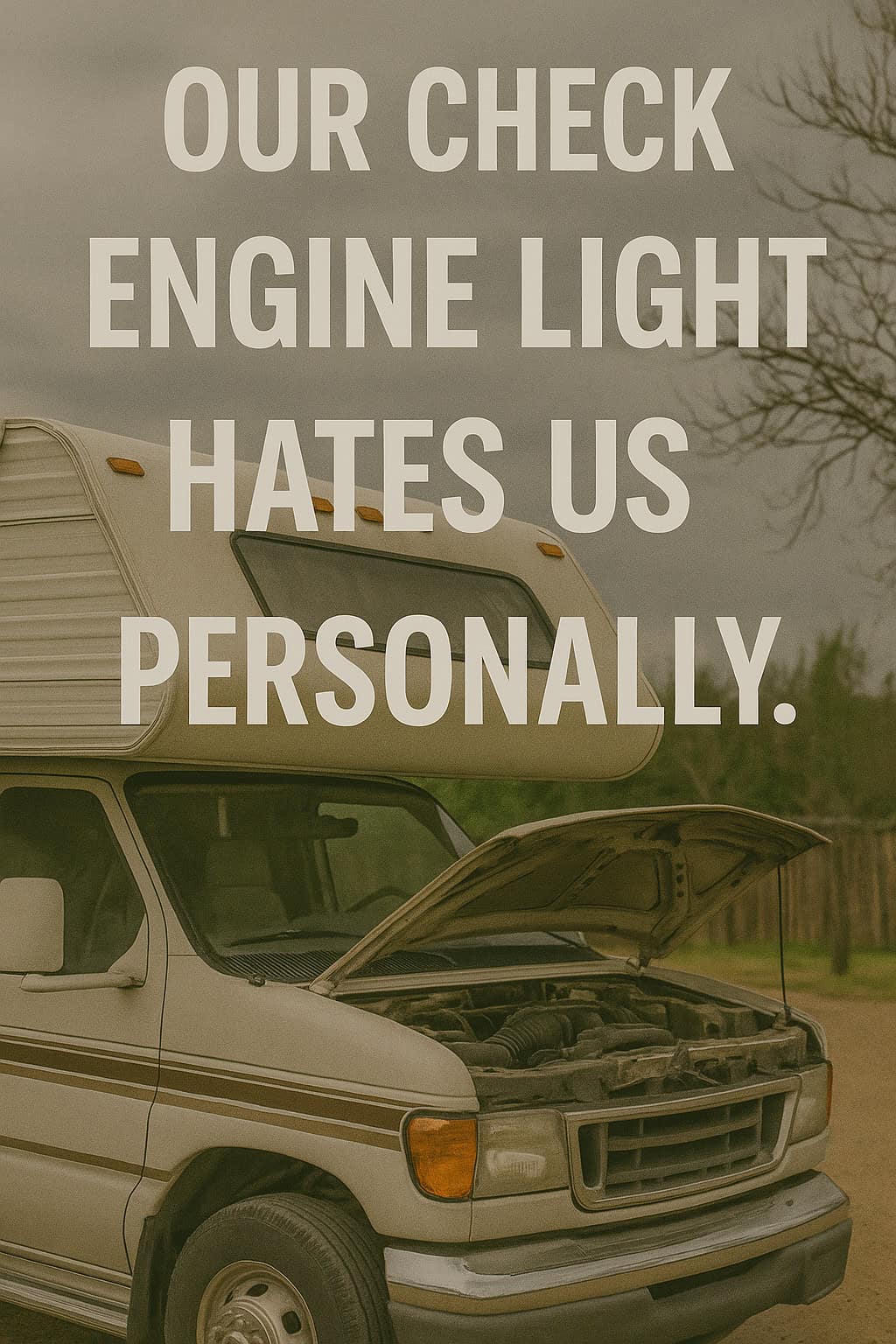
(Because it doesn’t illuminate for “issues”—it illuminates for drama.)
Some people see a check engine light and think,
“Oh, better get that looked at.”
RV people see a check engine light and think:
“Why? Why TODAY? What did we do to deserve this?”
It’s never just a light.
It’s a threat. A mood. A personal attack delivered at highway speed.
Here’s why the check engine light feels like it has a vendetta—and how to survive its emotional terrorism.
🚨 1. The Timing Is Always Suspicious
The check engine light doesn’t appear when:
-
you’re home
-
you’re near a mechanic
-
you’re in the mood for a challenge
It appears:
-
halfway up a mountain
-
40 miles from signal
-
just after you said “the rig is running great lately!”
Coincidence? Absolutely not. It heard you.
🔍 2. The Light Means Everything and Nothing
Could be:
-
loose gas cap
-
bad sensor
-
misfire
-
catastrophic doom
Or it could just be… a Tuesday.
The check engine light specializes in ambiguity. It wants you stressed but not informed.
📊 3. Every RVer Has Become an Amateur Code Reader
You start carrying an OBD-II scanner like it’s a lucky charm.
Now you’re out here interpreting codes like:
-
P0442 = “Eh, probably fine.”
-
P0300 = “Why multiple misfires? Why not just one??”
Suddenly you’re diagnosing the engine like you work at a dealership.
🧠 4. You Develop Light-Based Emotional Responses
Solid light? Concern.
Flashing light? Panic.
Light turns off randomly? Absolute paranoia.
Your brain goes:
-
“It’s gone… but is it really gone?”
-
“Is this peace? Or the calm before a $1,200 repair?”
The light has created trust issues. Deep ones.
🛠 5. The “Ignore and Pray” Strategy Is Not Your Friend
We’ve all tried it:
-
“Let’s see if it resets.”
-
“Maybe it’s just the sensor.”
-
“It’s running fine, so…”
The RV hears this and responds by glowing brighter out of spite.
👃 6. Your Senses Become Hyper-Aware
Light comes on → suddenly you’re:
-
sniffing air vents
-
listening for new knocks
-
monitoring RPMs like you’re flying a jet
-
touching the steering wheel like it’ll reveal clues
Nothing builds character like turning into Sherlock Holmes with a socket set.
🛞 7. You Start Bargaining With the Rig
“Just get us off the highway.”
“Just get us to the campground.”
“Just get us through this roundabout without exploding.”
You’re not praying—you’re negotiating with machinery.
🔧 8. The Reality: It’s Usually Not Personal
Most check engine triggers are minor:
-
O2 sensors
-
gas cap
-
emissions quirks
-
misreads after rough roads
The RV doesn’t hate you.
It’s just communicative in a way that feels like an attack.
Still, ignoring a steady light is one thing. Ignoring a flashing one? No. Pull over. No heroics.
🧰 9. The RVer’s Check Engine Toolkit
Keep this onboard and you’ll go from panicked to prepared:
-
inexpensive OBD-II scanner
-
gloves
-
basic tools
-
spare gas cap
-
flashlight
-
your roadside assistance number because, let’s be honest, you’ll need it one day
Preparedness = less fear when the light does its usual performance.
💬 Final Thoughts
The check engine light doesn’t hate you personally…
It just expresses itself with terrible timing and maximum emotional impact.
But once you understand what it means (and what it doesn’t), it becomes less of a crisis and more of a mildly toxic friend—annoying, dramatic, but manageable.
🐟 Want fewer check engine panic moments en route? Use Campground Views to preview your approach roads, grades, tight turns, and site layout—so you’re not adding unnecessary stress before the light decides to “share its feelings.”
🔗 Follow us for more RV life truths, on-road sanity tips, and humor for anyone whose dashboard enjoys jump scares.