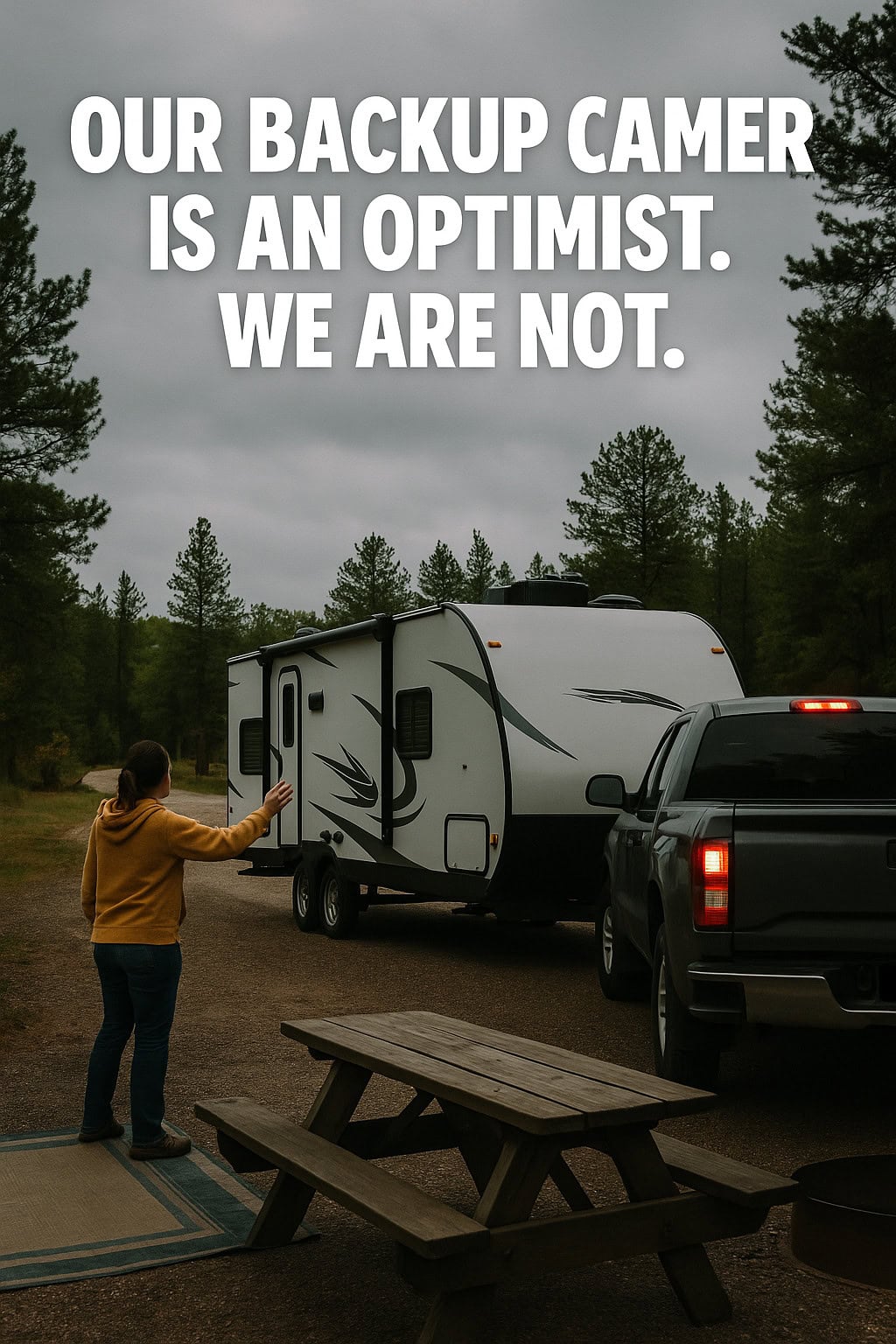
(Because “you’re good” is not a measurement — it’s a gamble.)
Backing up an RV is a special kind of experience. Not because it’s impossible — because it’s public, high-stakes, and full of equipment that behaves like it’s never met reality.
And nothing sums it up better than this:
our backup camera is an optimist. We are not.
The camera says: “Plenty of room.”
We say: “That’s what it wants us to think.”
1) The Camera View Is Always… Confident
The screen gives you a clean image, bright lines, and that calm little perspective that makes it seem like you’re just reversing a normal vehicle into a normal space.
But you’re not.
You’re reversing a rolling apartment with a turning radius that’s powered by stress.
So when the camera shows the campsite behind you, you don’t feel reassured.
You feel suspicious.
2) The Distance Lines Are Basically Decorative
The coloured lines on the screen are cute.
They act like they know what “close” means.
But in reality, they’re more like:
-
“green = probably fine”
-
“yellow = maybe fine”
-
“red = this is where your confidence goes to die”
-
“beeping = you will now make a decision under emotional pressure”
They don’t show: the swing, the angle, the branch, the rock, or the picnic table that’s somehow migrating closer as you reverse.
3) The Camera Has a Different Definition of “Clear”
The camera says it’s clear.
Then you step outside and see:
-
a stump
-
a fire ring
-
a hidden rock
-
a low post
-
someone’s bike
-
a dog wandering like it owns the loop
The camera is not lying.
It’s just… selectively optimistic.
4) The Screen Makes Everything Look Farther Away
This is the #1 emotional betrayal.
The screen shows the object behind you and it looks comfortably distant… like you’ve got time to adjust.
Reality says:
That object is now in your personal space.
That object is now a threat.
That object is now close enough to introduce itself.
5) Nighttime Backing Turns the Camera into a Horror Film
Back up in daylight? Stressful, but manageable.
Back up at night and the camera becomes:
-
grainy
-
washed out
-
full of glare
-
one moth away from total blindness
Everything is just shadows, and your brain fills in the gaps with worst-case scenarios.
6) Your Co-Pilot Becomes the Real Sensor System
At this point, the camera is basically for vibes.
The real backup system is:
-
your co-pilot’s frantic hand signals
-
“STOP STOP STOP” yelled with conviction
-
mirror checks every two seconds
-
you rolling back at 0.5 mph like you’re diffusing a bomb
Your co-pilot is doing air-traffic control while you pretend you’re calm.
7) Backing In Is Always a Performance
There’s always someone watching.
A neighbour suddenly appears to “walk their dog” exactly when you start reversing.
People sit outside like they’ve bought tickets.
Someone offers unsolicited advice.
Your backup camera remains optimistic.
You remain emotionally prepared for failure.
8) And Yet… The Camera Still Helps
Here’s the fairness clause: we mock it, but we use it.
It helps you:
-
keep alignment
-
see where the rig is drifting
-
avoid obvious obstacles
-
reduce the chaos (slightly)
It’s optimistic, sure — but it’s part of the team.
Final Thoughts
A backup camera in an RV is like that friend who is always positive: “Don’t worry! It’ll work out!”
Meanwhile you, the driver, are in the trenches thinking: “I would like evidence.”
So yes:
Our backup camera is an optimist. We are not.
But between its hopeful little screen and your very real caution, you usually get the rig parked without incident.
Usually.
🐟 Want fewer tight sites and less backing-in drama?
Use Campground Views to preview the approach, site geometry, and obstacles before you arrive—so you’re not relying on optimism (from a camera) at the worst possible moment.