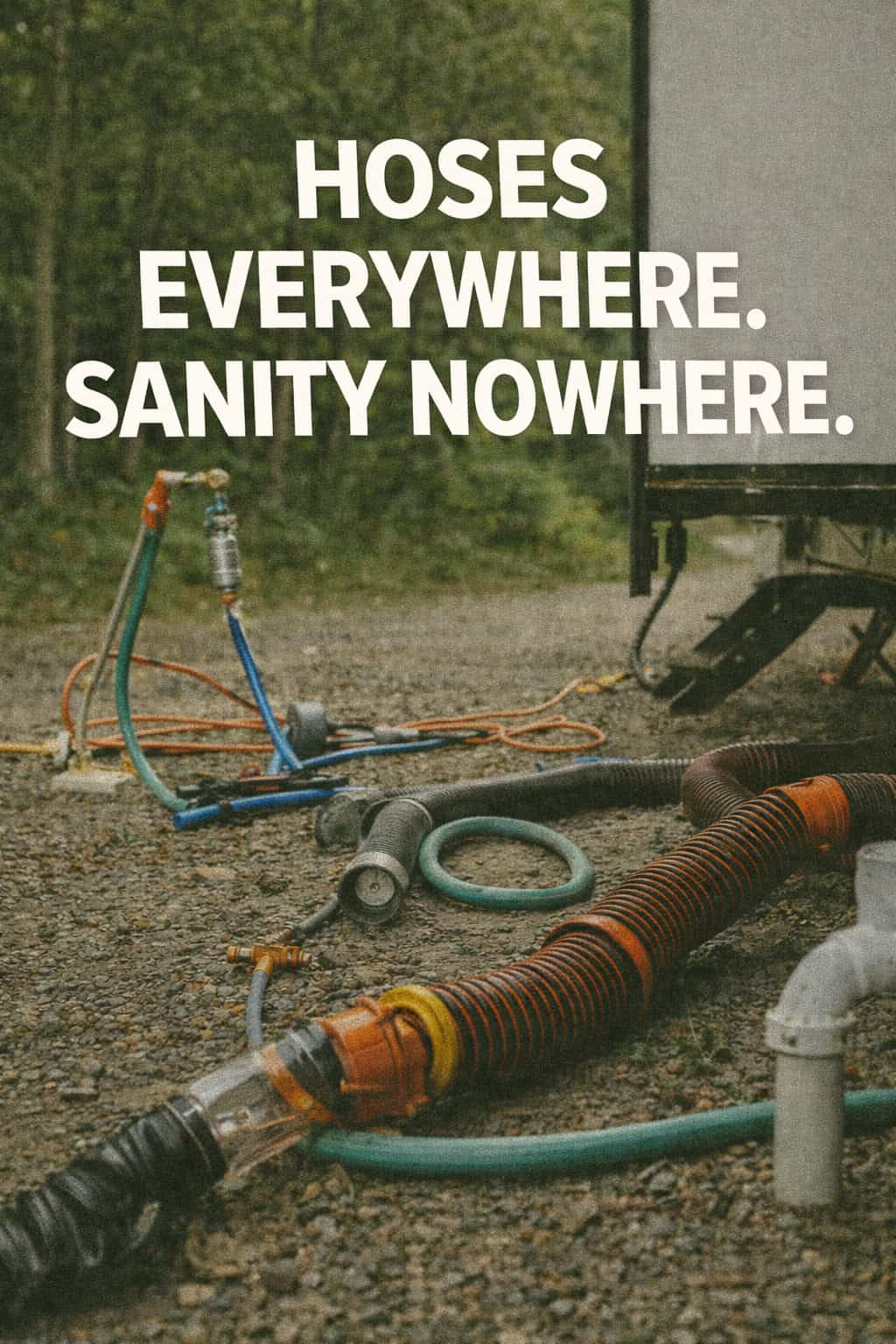
(Because nothing says “relaxing getaway” like tripping over your own infrastructure.)
You didn’t buy an RV to become a part-time plumber.
And yet here you are—at every stop—building a small, functional utility network like you’re running a remote research station.
Water hose. Sewer hose. Power cord. Sometimes two adapters. Sometimes three.
And once it’s all laid out, your campsite looks less like “vacation” and more like a very polite hazard course.
Hoses everywhere. Sanity nowhere. Let’s talk about it.
🚿 1. The Water Hose Is Never the Right Length
It’s always:
-
too short when you need it to reach
-
too long when you want it tidy
-
kinked when you need steady flow
-
and somehow always touching something you’d prefer it didn’t
You coil it neatly. It uncoils itself.
It’s not equipment. It’s a personality.
🧻 2. The Sewer Hose Is… a Relationship Test
The sewer hose isn’t difficult because it’s complicated.
It’s difficult because it’s emotionally loaded.
It requires:
-
gloves
-
slope awareness
-
confidence you don’t actually feel
-
and a level of respect you don’t give any other object
And yes, it will wait until you’re tired to misbehave.
🔌 3. Power Cords Have One Setting: Tangled
No matter how carefully you wrap it, a power cord will:
-
twist
-
loop
-
snarl
-
and form a knot that feels deliberate
Then you’re kneeling in gravel, muttering corporate-approved phrases like:
“This is not an efficient process.”
🧭 4. Everything Must Be Routed Like a Risk Assessment
Once the hoses are down, you realize:
-
people have to walk here
-
dogs will run here
-
you will forget and trip here in the dark
So now you’re doing layout planning:
-
keep lines close to the RV when possible
-
avoid crossings
-
reduce slack
-
keep the “walkway” clear
Congratulations—you’re now the site’s Health & Safety Officer.
🪤 5. The Real Enemy: The Trip Loop
You can avoid tripping for hours… until you don’t.
It’s always the same moment:
-
you’re carrying something
-
your brain is elsewhere
-
it’s slightly dark
-
the hose is slightly raised
And suddenly you do the tiny stumble that steals your dignity but spares your knees. Usually.
🌙 6. Night-Time Makes Everything Worse
In daylight, you can see the setup.
At night:
-
everything becomes invisible
-
the hose becomes a trap
-
and your torch is pointed at the wrong thing because you’re half asleep
If you’ve ever stepped outside to “just quickly check something” and nearly ate pavement—welcome.
🧠 7. The Pros Don’t Have Fewer Hoses — They Have Systems
This is the truth no one tells you.
Experienced RVers don’t magically have cleaner setups.
They just:
-
pack hoses in dedicated bins
-
keep fittings together
-
use color cues
-
coil and store consistently
-
lay things out the same way every time
Systems aren’t boring. They are how you protect your sanity.
🧼 8. Containment Is the Secret to Looking Like You’ve Got It Together
If you want your site to look less like a spaghetti incident:
-
keep hoses tight and routed
-
coil excess length
-
store accessories in one “hookup kit”
-
keep sewer gear isolated (always)
Even a slightly tidy setup makes you feel 300% more competent—regardless of reality.
💬 Final Thoughts
Hoses are the part of RV life nobody romanticizes—yet everyone lives.
They’re messy, awkward, and essential.
And once you accept that you’re basically setting up a mini utility grid every time you park, it becomes less frustrating and more… familiar chaos.
You may not have sanity.
But you’ll have running water.
And frankly, that’s a strong trade.
🐟 Want fewer awkward hose gymnastics on arrival? Use Campground Views to preview hookup placement, site angles, and spacing before you book—so you know whether you’ll be doing a clean setup… or a full spaghetti deployment.
🔗 Follow us for more RV life truths, campsite systems, and humor for people who’ve absolutely tripped over their own hose and blamed the wind.