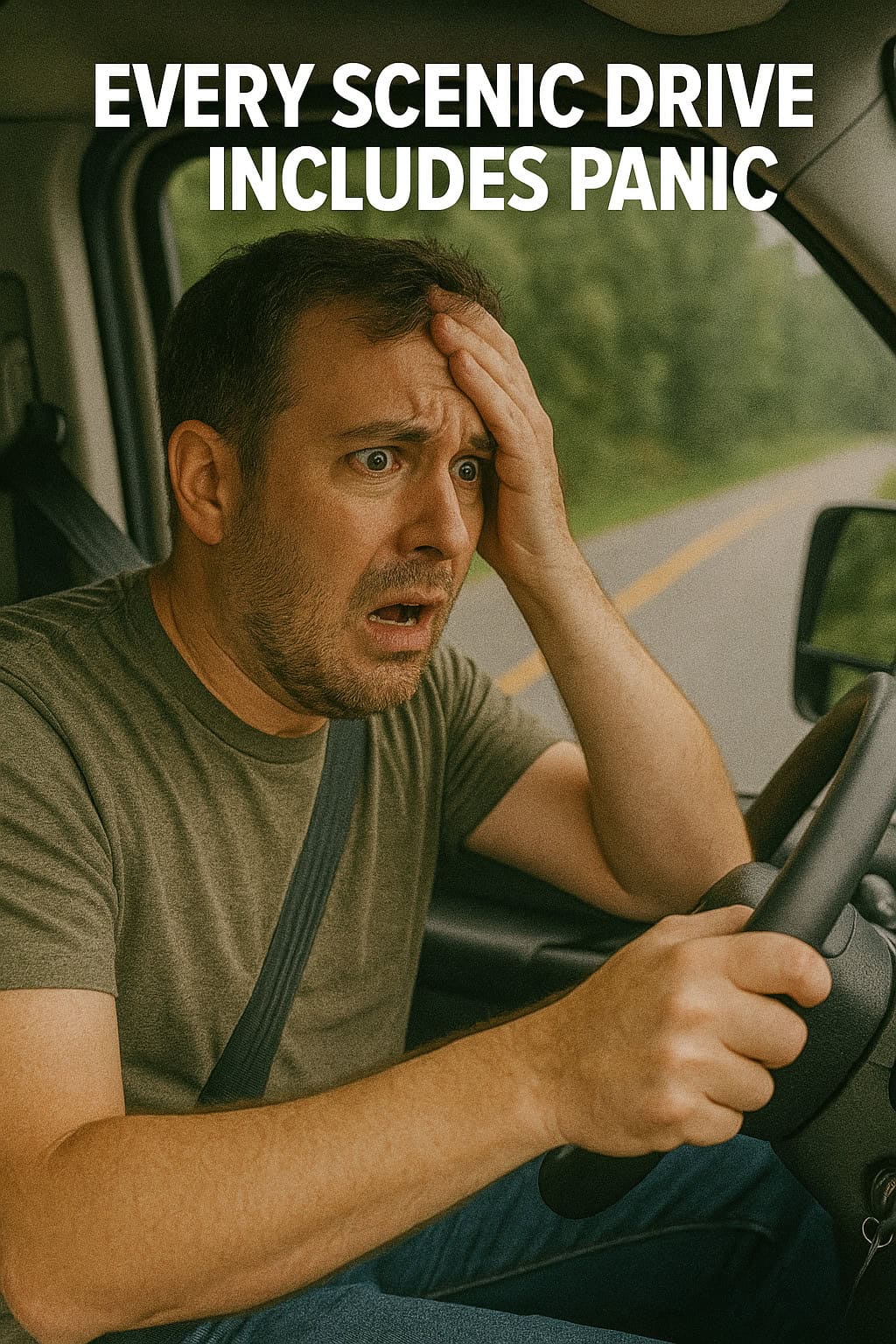
(Because the views are stunning and the guardrails feel… optional.)
You set out expecting beauty.
Mountains. Water. Curves that look great in photos.
What you get instead is a white-knuckle masterclass in restraint, geometry, and deep breathing—performed while pretending you’re definitely enjoying the scenery.
Scenic drives are gorgeous.
They’re also where RV confidence goes to be stress-tested.
Here’s the honest breakdown of why every “wow” view comes with a side of panic—and why we keep doing it anyway.
🧭 1. The Road Is Narrower Than Your Optimism
The listing said “scenic byway.”
What it meant was: one-and-a-bit lanes, no shoulder, and vibes.
You’re suddenly:
-
hugging the center line
-
whispering apologies to oncoming traffic
-
wondering who approved this for vehicles larger than a bicycle
And yes, your rig technically fits.
Emotionally? It does not.
🛞 2. Drop-Offs Appear With Zero Warning
One minute you’re admiring the view.
The next, you notice:
-
no guardrail
-
a dramatic slope
-
your passenger going very quiet
You don’t look down.
You don’t talk about it.
You focus straight ahead like a professional who absolutely planned this route.
🚚 3. Oncoming Traffic Feels Personal
Every approaching vehicle looks:
-
wider than it is
-
faster than necessary
-
deeply committed to the center line
You slow down.
They don’t.
And now you’re negotiating space like it’s a social experiment.
Bonus panic points if it’s:
-
a tour bus
-
a logging truck
-
another RV that looks confident
🔄 4. The Curves Are Having Too Much Fun
Scenic roads love curves.
Your cupboards do not.
You take corners thinking:
-
“Was that tighter than expected?”
-
“Why is everything shifting?”
-
“That sounded expensive.”
You’re driving carefully, but the road keeps saying, “Surprise.”
⛰ 5. Uphill: Slow and Judged
Downhill: Fast and Feels Wrong
On the climb:
-
engine noise increases
-
speed decreases
-
small cars pass you with opinions
On the descent:
-
gravity gets bold
-
brakes feel important
-
you’re very aware of your weight
You are now thinking about physics more than the scenery.
📵 6. No Signal = Full Commitment
Scenic routes are allergic to mobile signal.
Which means:
-
no rerouting
-
no quick checks
-
no “let’s just see what’s ahead”
You’re in it now.
You finish the road because that’s the only option left.
This is not bravery. This is logistics.
🧠 7. The Mental Load Is Exhausting
You’re managing:
-
lane position
-
speed
-
mirrors
-
wind
-
elevation
-
that one cyclist who appeared out of nowhere
All while someone says, “Wow, look at that!”
And you reply, through clenched teeth, “Yep. Gorgeous.”
You don’t relax until the road straightens.
Then you realize your shoulders are by your ears.
🪑 8. The Passenger Experience Is… Different
Drivers get panic.
Passengers get:
-
photos
-
commentary
-
sudden silence when it gets spicy
They say helpful things like:
-
“You’re doing great.”
-
“Just go slow.”
-
“Oh wow, there’s nothing between us and the edge.”
Supportive. Truly.
🌄 9. And Yet… You’d Do It Again
Because when it’s over:
-
the view really was incredible
-
the road eventually widened
-
nothing fell off
-
everyone survived
You park, step out, and think: “Okay… that was terrifying. But also worth it.”
And later—much later—you’ll recommend the drive to someone else. Casually. Like it was no big deal.
💬 Final Thoughts
Scenic drives are a paradox.
They’re the reason you travel—and the reason your heart rate spikes.
They demand focus, patience, and the ability to enjoy beauty after you’ve stopped moving.
And that’s okay.
Panic doesn’t mean you’re bad at this.
It means you respect the road, your rig, and the fact that some views are earned through tension.
🐟 Want to preview those “scenic” approaches before you commit? Use Campground Views to check road access, turns, grades, and site approaches—so you know whether a drive is “pleasantly winding” or “deep breaths and silence.”
🔗 Follow us for more RV life truths, road-trip survival tips, and humor from people who’ve admired scenery only once the wheels stopped turning.