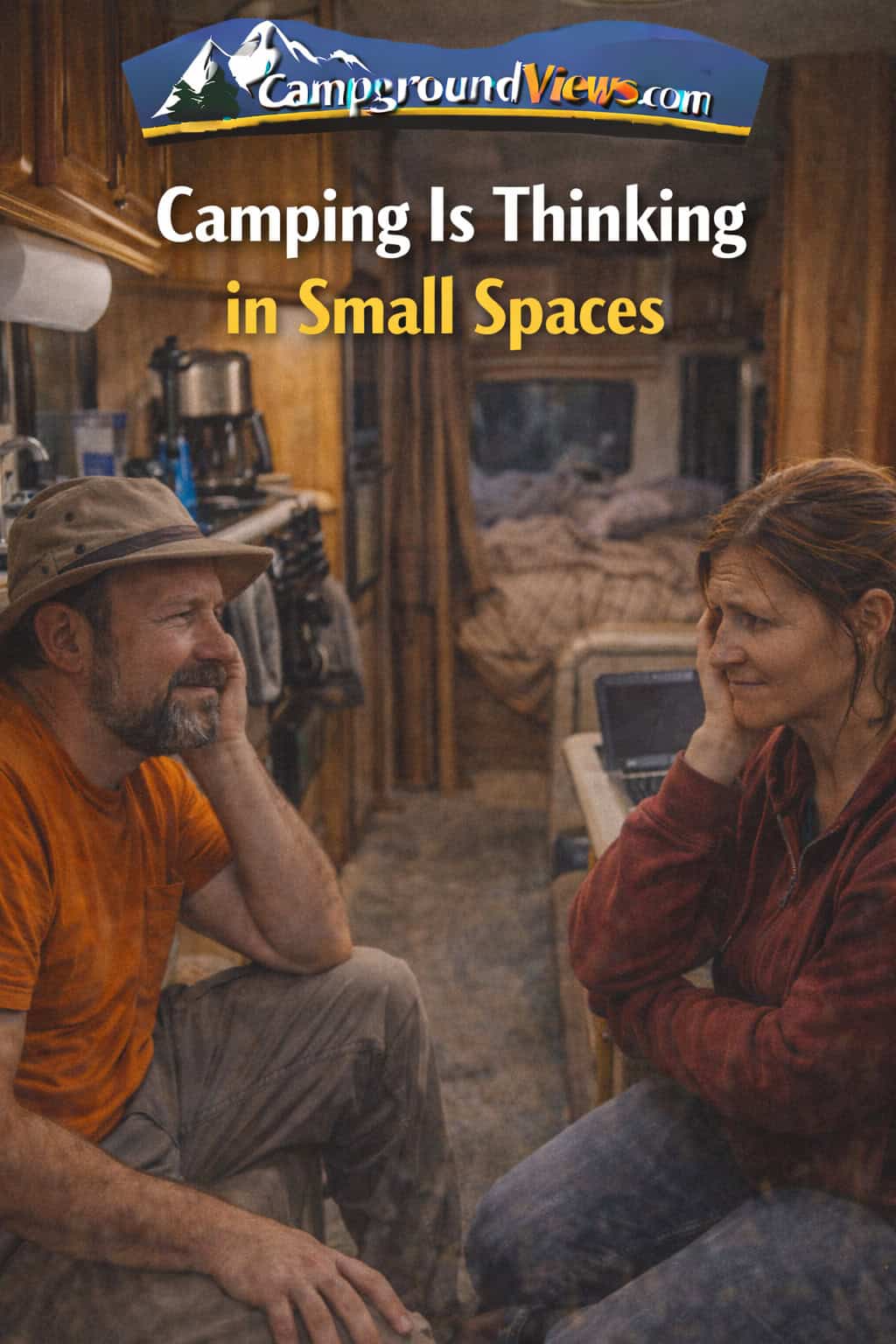
(Physically compact. Mentally expansive.)
You thought camping would be about nature.
Fresh air.
Wide-open views.
And it is.
But mostly?
Camping is about thinking very carefully in very small spaces.
🧠 1. Every Decision Has Physical Consequences
In a house, you can be vague.
Here? If you put something down:
-
it blocks something
-
leans on something
-
or becomes a future obstacle
Nothing is neutral.
Every object has an opinion.
🪑 2. Space Is Not Just Limited — It’s Multi-Purpose
One surface is:
-
a table
-
a counter
-
a seat
-
storage
-
and occasionally a mistake
You don’t ask, “Where does this go?”
You ask: “What else needs this space in five minutes?”
🧩 3. Order Matters More Than You’d Like
You can’t do things in any order.
You must:
-
move one thing
-
to access another
-
to make room for a third
This is not inefficiency.
This is spatial choreography.
One wrong move and you reset the whole sequence.
🚿 4. Activities Overlap Emotionally
You can’t just:
-
cook
-
clean
-
shower
-
change
-
or sit
Each action affects:
-
humidity
-
movement
-
access
-
and mood
Camping is less about tasks and more about timing coexistence.
🧠 5. You’re Constantly Running Micro-Calculations
Your brain quietly asks:
-
“If I do this now, what does it interrupt?”
-
“Can this wait until after that?”
-
“Will this make something else harder later?”
This is not stress.
This is logistics with cushions.
🪜 6. You Learn to Think Vertically
Walls matter.
Hooks matter.
Corners matter.
Anything that can:
-
hang
-
fold
-
stack
-
or collapse
Becomes emotionally valuable.
Flat surfaces are a luxury.
Vertical thinking is survival.
😅 7. Sitting Down Is a Strategic Choice
You don’t sit casually.
You sit when:
-
nothing is pending
-
nothing needs access
-
and no one else needs the space
Sitting down says: “We are done for now.”
That’s a powerful statement in a small space.
🧠 8. Eventually, Your Brain Adapts
At first, it’s tiring.
Later? It becomes intuitive.
You stop noticing the calculations because they’re automatic.
Your brain expands to match the constraints.
This is the quiet skill camping teaches.
💬 Final Thoughts
Camping isn’t about having less space.
It’s about thinking better within it.
You become:
-
more intentional
-
more aware
-
more efficient
-
and oddly more present
Because when space is limited, attention sharpens.
And when attention sharpens—
even small spaces feel meaningful.
🐟 Want campsites where the small-space thinking feels easier from the start? Use Campground Views to preview site layout, spacing, and setup before you book—so fewer mental puzzles stack up at once.
🔗 Follow us for more RV life truths, spatial realism, and content for people who’ve absolutely thought, “Why does this require so much planning?” while standing three feet from everything they own.