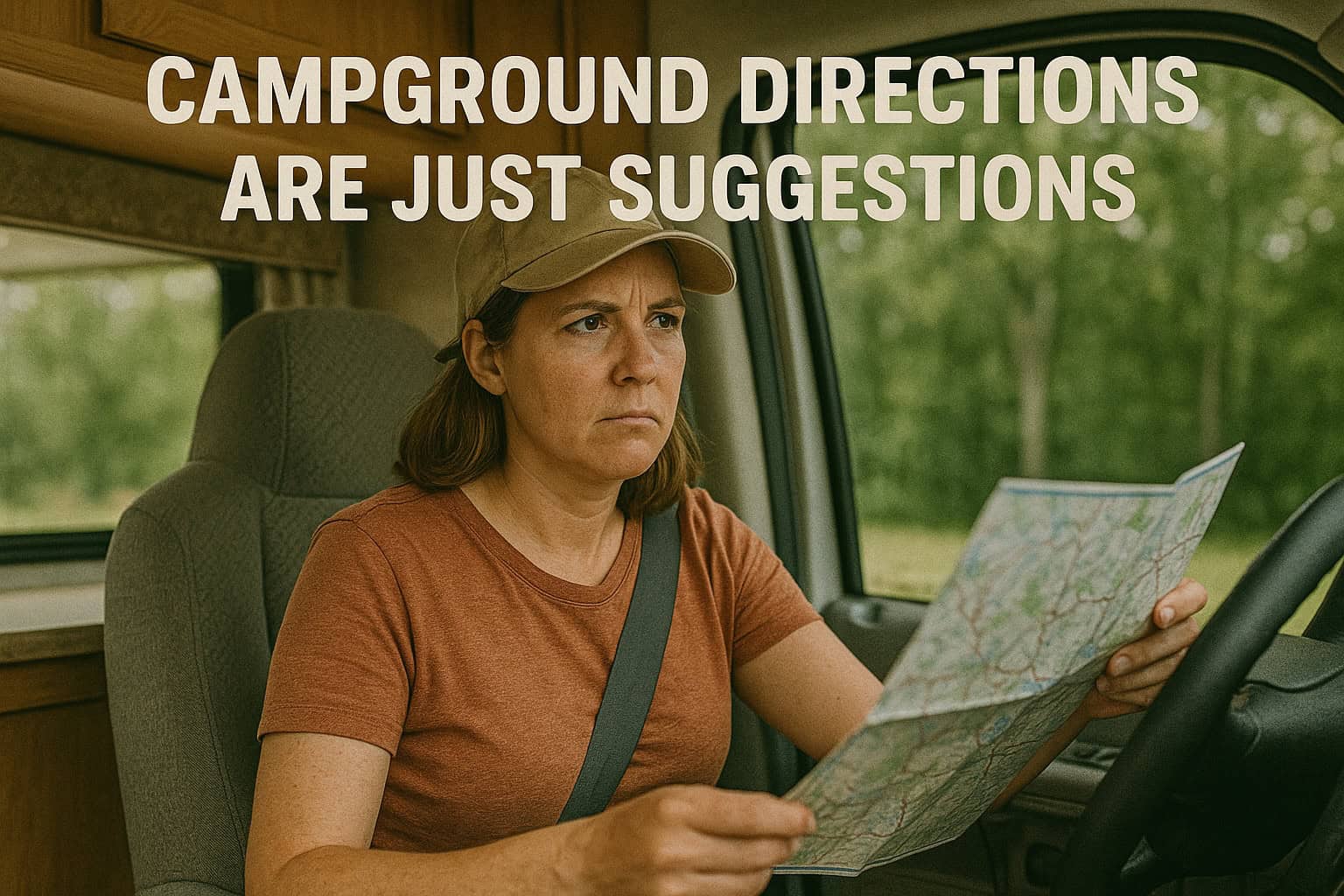
(Because “follow the signs” is adorable advice in a place with 37 identical turns.)
You ever notice how confident campground directions sound?
“Take the second left, follow the loop, pass the bathhouse, and your site will be on the right.”
Great. Easy. Simple.
And then you arrive and suddenly every road looks the same, the signs are either missing or vague, and you’re circling Loop C like you live there now.
Because here’s the truth:
Campground directions are just suggestions.
1) The Map Looks Clear… Until You’re Actually Driving It
The campground map is always a cute little drawing with tidy loops and helpful labels.
In real life, it translates to:
-
“road curves unexpectedly”
-
“sites are hidden behind trees”
-
“everything is beige”
-
“you cannot stop to interpret this map without blocking everyone”
So you’re driving slowly, squinting, and trying to act like you know what you’re doing.
2) There Are 19 Signs, and None of Them Say What You Need
Campground signage is built on vibes.
You’ll see:
-
“SLOW” (yes, obviously)
-
“QUIET HOURS” (helpful, but not now)
-
“NO FIREWOOD” (not relevant)
-
“BATHHOUSE” (great, thank you)
But the one sign you need — “SITE 42 THIS WAY” — is either:
-
too small
-
behind a branch
-
turned the wrong direction
-
or simply not there
You’re not lost. You’re just under-informed.
3) Site Numbers Follow Their Own Spiritual Logic
You’d think site numbers would be sequential.
You’d think wrong.
You’ll pass:
-
Site 12
-
Site 14
-
Site 19
-
Site 3
-
Site 11
-
and then Site 47, somehow
It’s less “numbered sites” and more “a scavenger hunt for adults with large vehicles.”
4) The Campground Host Gives Directions Like You’ve Been There Before
They’ll say something like: “Oh yes, you’re in Maple Loop, just past the big rock, third lane on the left, near the split stump.”
And you nod politely while thinking:
“What big rock?”
“Which stump?”
“Why is this like a riddle?”
You leave the office with confidence… and lose it 90 seconds later.
5) You Can’t Turn Around Without Making It Everyone’s Problem
The most stressful part isn’t being lost.
It’s being lost in a rig that can’t casually U-turn.
So you do the campground crawl:
-
6 mph
-
hazard lights maybe
-
co-pilot leaning forward like they can see better through determination
-
trying not to look like you’re touring the loop for fun
And every time you miss the turn, you just keep going because reversing here would be a public event.
6) Your Co-Pilot Turns Into a Navigation Courtroom
This is where the debates happen:
“That’s the turn.”
“No, that’s a service road.”
“It says loop B!”
“Why are we in loop D then?”
“Did you see a sign?”
“I saw something!”
“That wasn’t a sign, that was a birdhouse.”
Campground navigation doesn’t cause fights.
It causes strong discussions outdoors.
7) Eventually, You Find It… Accidentally
You don’t locate your site through directions.
You locate it through:
-
luck
-
pattern recognition
-
a random neighbour pointing
-
or the moment you see your number and feel instant relief
And then you pretend this was intentional the whole time: “Yep. Right where we expected.”
Final Thoughts
Campground directions are helpful… in theory.
In practice, they’re often more like a gentle suggestion paired with a mild test of your patience.
So yes:
Campground directions are just suggestions.
And if you can find your site without circling the loop twice, congratulations — you’ve achieved elite-level RV navigation.
🐟 Want to know the layout before you roll in? Use Campground Views to preview the campground roads, loops, and site placement so you arrive looking calm—even if you’re not.