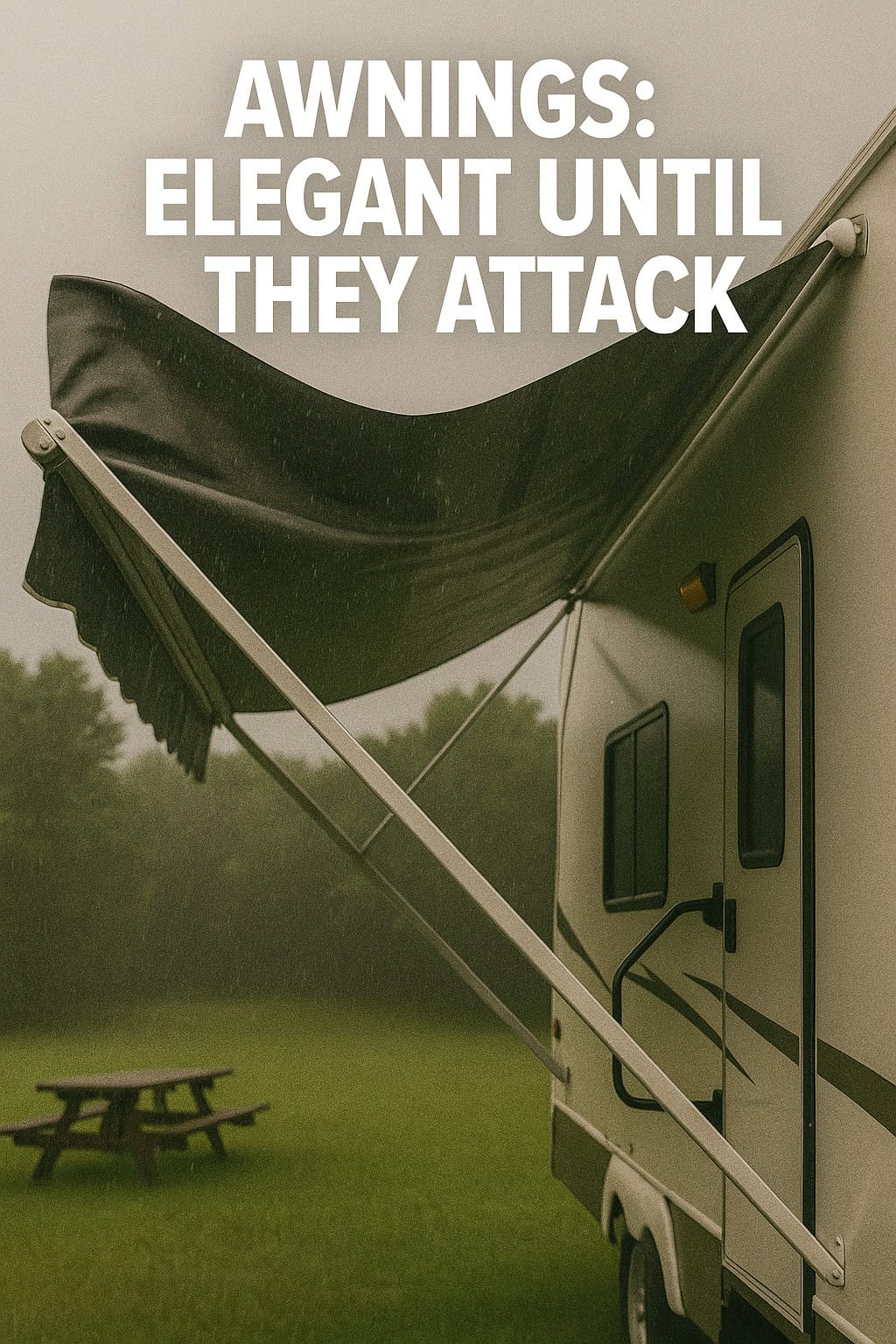
(Because nothing says “relaxing campsite” like fabric trying to become a parachute.)
Awnings are beautiful in theory.
They glide out smoothly, cast perfect shade, and make your site look like you’ve got your life together.
And then the wind shifts.
Suddenly your elegant shade canopy becomes:
-
a flapping monster
-
a squealing accordion
-
a stress test with aluminum bones
Awnings are classy… right up until they choose violence.
Here’s why they get dramatic, how to keep them from attacking, and what experienced RVers do to avoid the dreaded “awning incident.”
🌬 1. Wind Is the Awning’s Love Language (Unfortunately)
The biggest lie campers tell themselves is:
“It’s only a light breeze.”
Wind escalates fast. And your awning catches it like a sail.
If your awning is out and you notice:
-
stronger gusts
-
trees starting to sway
-
sudden temperature drop
-
that “storm smell” in the air
That’s your cue to retract. Early. Calmly. Like a professional.
👀 2. Awnings Don’t “Warn” You — They Perform
Awnings don’t fail quietly. They announce.
The early warning signs:
-
fabric flapping hard
-
arms bouncing
-
loud snapping sounds
-
one corner lifting
If you hear a sound that makes you look up fast—do not negotiate. Retract it.
🪢 3. Tie-Downs Can Help… But They’re Not a Force Field
Yes, straps and stakes can add stability.
No, they are not magic.
In strong gusts, tie-downs can:
-
pull weirdly
-
stress hardware
-
make damage worse if the awning catches a big gust
Tie-downs are for mild conditions—not “wind event” conditions.
The safest awning in big wind is the one that’s rolled in.
📐 4. Pitch Matters: Flat Awning = Water Balloon
Rain adds another layer of betrayal.
If you leave it flat during rain, water can pool and suddenly you’ve got:
-
sagging fabric
-
heavy load
-
a surprise dump of water when you move it
Best practice:
-
pitch one side lower so water runs off
-
check it during rainfall
-
retract if heavy rain + wind combo shows up
Because nobody wants the “awning waterfall” moment over the campsite rug.
🧰 5. The “Quick Fix” Is Usually “Put It Away”
When awnings act up, our instinct is to fiddle:
-
adjust legs
-
tighten straps
-
move the mat
-
negotiate with the sky
But the real fix is often: retract the awning, wait it out, redeploy later.
You’re not giving up. You’re protecting expensive fabric with mechanical feelings.
🚪 6. The Awning Attack Usually Happens When You’re Not Watching
Awnings behave best when you’re actively monitoring conditions.
They attack when:
-
you left for a walk
-
you went into town
-
you fell asleep
-
you assumed the weather would “stay like this”
If you leave the site or turn in for the night, the best practice is simple: roll it in.
😅 7. Why We Keep Using Them Anyway
Because when conditions are calm, awnings are the best.
They give you:
-
shade
-
cooler interior temps
-
defined outdoor space
-
instant “this is home” energy
They’re not evil. They’re just… weather-sensitive extroverts.
💬 Final Thoughts
Awnings are elegant, useful, and incredibly dramatic.
Treat them like a high-maintenance friend:
-
great company
-
not trustworthy in a storm
-
needs supervision
-
should not be left alone with wind
If you retract early and redeploy when it’s calm, you’ll keep your awning intact, your campsite peaceful, and your stress levels in the “normal camping chaos” range.
🐟 Want to know whether your site is exposed to wind—open field, lakefront, ridge, or tight tree cover? Use Campground Views to preview site layout, surrounding terrain, and exposure before you book, so your awning doesn’t become the entertainment.
🔗 Follow us for more RV life truths, campsite sanity tips, and humor for people who’ve absolutely sprinted outside in socks to save an awning.